What is casein? Effect, intake, forms
Casein is the slow milk protein: around 80 % of milk protein, a gel in the stomach, amino acids over 6 to 8 hours. Here you will read how the effect comes about, which form suits what, how to take it and whether casein can be harmful.

Casein is the slowly digested main protein of milk: about 80 % of milk protein consists of it, the remaining 20 % is whey protein2. In the stomach it clots into a fine gel and releases its amino acids over 6 to 8 hours instead of in one short spike. Exactly these properties make it the protein for the night, for long gaps between meals and for dieting. Here you will read how the casein effect comes about, which variant suits what, how to take it and whether casein can be harmful; written for athletes and for anyone who wants to know what is in quark, cheese and casein powder.
Key takeaways
- Milk protein number one: around 80 % of milk protein is casein, bundled in micelles with calcium and phosphate. Cheese, quark and skyr consist mostly of it.
- Effect: it clots in the stomach and releases its amino acids over 6 to 8 hours; the evening shake secures your protein supply through the whole night.
- Three types: micellar casein (the standard in protein powders), calcium caseinate (more soluble, thinner) and hydrolysate (pre-digested, fast). For the evening shake, micellar is the best choice.
- Intake: 30 g in 250 to 300 ml, 30 to 60 minutes before sleep. In our shop: three micellar caseins from GN Laboratories, PEAK and Stacker2 with 74 to 82 g of protein per 100 g.
- Safety: casein is a normal component of milk. The cancer debate comes from rat experiments with the mould toxin aflatoxin. It is only off limits with a milk protein allergy.
What exactly is casein? Definition and structure
Casein is a milk protein, more precisely a group of four proteins: αs1-, αs2-, β- and κ-casein. In milk they form spherical micelles in which calcium phosphate is embedded. κ-casein sits on the outside and keeps the micelle stable in the liquid, while the αs1-, αs2- and β-caseins with the calcium lie inside: this is how milk transports protein and nutrients such as the mineral calcium in one package.

Cow's milk contains 3.3 to 3.5 % protein, of which about 80 % is casein and 20 % whey protein2. Casein is found in the milk of all mammals; in human breast milk, however, its share is smaller and whey protein predominates. The name comes from the Latin caseus, cheese: when cheese is made, casein curdles through the addition of rennet (with the help of the enzyme chymosin) or acid. The solid mass is almost pure casein, the whey contains the whey protein.
For protein powder it is obtained from skimmed milk in two ways. In microfiltration, membranes separate the components of the milk by particle size: the large micelles stay behind, lactose, whey protein and minerals pass through. This process yields micellar casein with an intact structure. In the production of calcium caseinate, the protein is precipitated with acid and dissolved again by neutralisation with calcium hydroxide. We compare the production and use of the three variants in the section below.
The casein effect: what happens in the body
Casein works slowly: in the acidic stomach it forms a soft gel, just as in cheese making. The gel leaves the stomach only gradually, and gastric emptying takes longer. The enzymes cut the protein piece by piece into amino acids; their absorption through the gut into the bloodstream takes correspondingly long. In the classic study by Boirie, the amino acid level rose steeply after whey and fell after about two hours; after casein it rose more gently but stayed elevated for over seven hours2. That is why the literature counts it among the slow proteins, in contrast to whey, the fast one3.
What does that mean for muscle growth and muscle maintenance? Protein contributes to the maintenance and growth of muscle mass1, and the casein shake delivers it over a longer period in which you otherwise eat nothing: the night. Two studies show the effect: strength athletes had a higher overnight muscle protein synthesis after 40 g before sleep than after placebo4. In a twelve-week training study, muscle mass and strength increased more with the evening shake5. More important than the timing is the total amount: the experts of the ISSN name 1.4 to 2.0 g of protein per kg of body weight per day as the basis for athletes7. The evening shake is the easiest way to reach that amount.
The amino acid profile is complete, including BCAAs, with slightly less leucine than whey. Then there is the calcium content: the micelles bind calcium, which the body needs for bones and teeth among other things1. Because the gel lasts long, the feeling of fullness also lasts longer, an advantage in dieting phases. Bodybuilders therefore call casein the night-time protein with an anti-catabolic effect: the steady supply of amino acids is meant to prevent the body from breaking down muscle during long gaps. A review by Trommelen and van Loon supports the principle: 30 to 40 g at night increase protein synthesis and can support adaptation to training6.
Micellar casein, calcium caseinate or hydrolysate: which form suits you?
For the evening shake, micellar casein is the best choice, calcium caseinate is the ingredient for bars and baking mixes, hydrolysate the special case for fast supply. The three types differ in production, processing and release, not in amino acid profile; none of the three is fundamentally better, each has its place.

Micellar casein
Micellar casein is casein in its natural structure: in microfiltration the micelles are only separated by particle size and remain intact. It dissolves into a thick, creamy shake, clots the most and releases the amino acids the slowest; that is why it ends up in practically every powder for the night, including the three products in our shop.
Calcium caseinate
Calcium caseinate is produced by acid precipitation followed by neutralisation with calcium hydroxide. The caseinate dissolves thinner and brings fewer carbohydrates (lactose) and less fat; that makes it the ingredient for bars, coffee creamer and baking mixes. We do not carry it as a standalone powder, but you will often come across it as an ingredient.
Casein hydrolysate
Hydrolysate is enzymatically pre-digested casein, the protein chains are cut into short peptides. In one study it was absorbed faster than the intact form, but intact casein was the protein with the longer effect8. It is not meant for the night, and it is more expensive and bitter in taste. More on this in the article Hydrolysed casein is absorbed faster.
Which form is best for your goal?
| Your goal | Suitable form | Why | In our shop |
|---|---|---|---|
| Night, long gaps, shift work, evening shake when dieting | micellar | slowest release, 22 to 24 g of protein for 104 to 118 kcal and little fat per serving | GN Laboratories, PEAK, Stacker2 |
| Poor lactose tolerance | micellar with lactase | lactase breaks down the residual lactose | PEAK |
| Right after the workout | whey protein instead of casein | fast amino acids after the session10 | whey range |
| Pudding, overnight oats, baking | micellar (pudding) or caseinate (ingredient) | thickens and binds | GN Laboratories or PEAK |
The three products in our shop at a glance
| Powder | Protein per 100 g | Protein per 30 g serving | Flavours | Special feature |
|---|---|---|---|---|
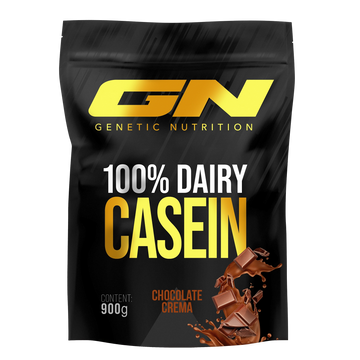
| 100% Casein Protein from GN Laboratories | 73.6 to 81.8 g depending on flavour | 22 to 24.5 g | Chocolate Crema, Vanilla Crema | made in Germany, no added sugar or colourings, 4.89 stars in our shop reviews |
| Micellar Casein by PEAK | 76 to 80 g depending on flavour | 23 to 24 g | Vanilla, Chocolate, Cookies & Cream, Strawberry, Coconut | with lactase, 104 kcal per serving |
| 100% Casein by Stacker2 | 75 to 79 g depending on flavour | 23 to 24 g | Vanilla, Chocolate, Strawberry | from milk protein concentrate and isolate, dissolves easily |
From our range

GN Laboratories 900 g
100% Casein Protein
Casein from GN Laboratories in Chocolate Crema and Vanilla Crema.
View productIn the last 90 days (as of August 2026), 62 % of casein orders in our shop went to the 100% Casein Protein from our house brand GN Laboratories, most chosen flavour: Chocolate Crema. If you want lactase included, take Micellar Casein by PEAK, and 100% Casein by Stacker2 offers three flavours to switch between. All three compared: buy casein protein.
Whey and casein: the differences in one minute
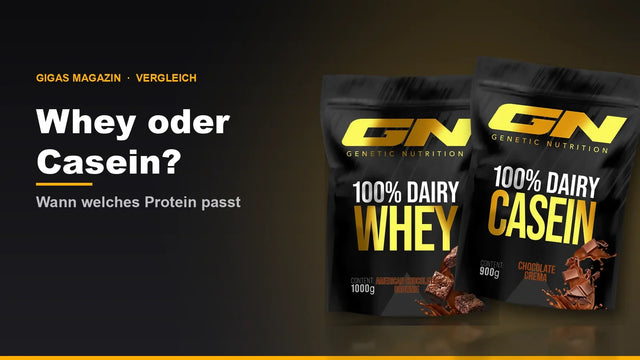
Whey is fast, casein is slow, that is the difference that matters, and it decides the timing. Both proteins come from the same milk and deliver a complete amino acid profile. Whey protein has the higher biological value and more leucine and is in the blood after 40 to 60 minutes. In the study by Tang, it stimulated muscle protein synthesis more strongly right after the session10. Casein, with its release over hours, belongs to the evening and to long gaps4.
| Property | Whey protein | Casein |
|---|---|---|
| Digestion | fast, peak after about one hour | slow, 6 to 8 hours |
| Amino acid level | high and short | flat and long |
| Consistency in the shake | thin | thick, creamy |
| Best time | after the workout, in the morning | evening, long gaps |
When whey protein, when casein?
Whey after the workout, casein before sleep: this combination works best in practice, the two proteins complement each other, and a multi-component protein is the mix of both. If you mostly drink your shake after the session, stick with whey protein; if you want to cover the night, add the slow protein. You can read the detailed comparison in Whey or casein: which protein when?
Taking casein: when, how much, how to mix
30 g, 30 to 60 minutes before sleep, in 250 to 300 ml of water or low-fat milk: that is the best time and the standard preparation. The gel behaviour already shows in the shaker: the shake gets thicker than with whey, so use more liquid and shake for 20 to 30 seconds, then no lumps remain. With milk the shake becomes creamier, with water it stays at 104 to 118 kcal per serving.
One serving a day is enough for most people. Two make sense in these cases: when more than five hours lie between two meals, for example with shift work, or when your daily protein intake would otherwise fall short; then one in the afternoon, one in the evening. A 900 g tub yields 30 servings, so a month at one and two weeks at two. With less liquid the powder turns into a protein pudding, in overnight oats it binds the oats and milk overnight; it is not a meal replacement. Whether the shake before sleep makes sense for you and how to use it when losing weight is covered in two further articles: Casein before sleep and Casein for weight loss.
Is casein harmful or carcinogenic?
No, for healthy people casein is safe: it is the main component of quark, cheese and milk, and the powder is that component in concentrated form. In the EU, caseins and caseinates are regulated as foods11, and there is no human study that proves casein to be a cause of cancer.
The question comes from The China Study, the book by biochemist T. Colin Campbell (2005). His conclusion was based mainly on rat experiments: the animals were given aflatoxin B1, a mould toxin that causes liver cancer, and then feed with 20 % or with 5 % casein. At 20 %, the precancerous lesions in the liver grew more9. That is a finding about poisoned rats and an extreme amount of protein, not about an evening shake in humans; no danger for normal consumption can be derived from it. The population data from China showed higher and lower cancer rates with more animal protein depending on the region; no cause follows from such correlations. A second myth concerns the casomorphins: when β-casein is digested, opioid-like peptides form briefly and are broken down in the gut; that milk is addictive because of this is not proven.
Who should be careful: with a milk protein allergy the immune system reacts against casein or whey protein, then it is off limits in every form. Lactose intolerance is something else: here the enzyme for milk sugar is missing, and the powder contains only little of it; with added lactase, as with PEAK, those affected usually cope well. A non-allergic intolerance shows mainly in digestion; symptoms, testing and what to eat then are explained in our guide Casein intolerance.
Casein in foods: where is how much of it?
Casein is in everything made from curdled cow's milk: quark, skyr, cottage cheese, hard and semi-hard cheese, yoghurt and milk itself. A glass of milk (300 ml) provides around 10 g of protein, of which about 8 g is casein. Cheese is almost pure casein because the whey runs off during cheese making. Low-fat quark provides about 12 g of protein per 100 g, mostly casein; for 30 g of it you eat about 250 g. Butter and cream contain only traces, eggs none at all, and plant drinks made from oats, soy or rice none either.
The shake does not replace dairy products, it complements them: 30 g of powder is quicker to drink than 250 g of quark, comes with less lactose and delivers the same amount of protein with less energy. The full table with the content in dairy products per 100 g and the question of which cheese does without casein can be found in the casein food table.
What is casein used for outside the kitchen?
Casein has also been a technical raw material for centuries, which is why the word appears in so many applications. As casein glue it served for gluing wood, and as a binder it is found in casein paints and in the coating of paper. Galalith, one of the first plastics for buttons and jewellery, was made from casein, and leather was finished with it. In the food industry it serves as a processing aid for fining wine and fruit juice, where it binds cloudy particles; that is why casein must be declared there as an allergen. Its use as a binder plays a small role today; for you as an athlete, the protein powder is what counts.
Conclusion: casein belongs in the long gaps
As a slow milk protein, casein supplies your muscles for 6 to 8 hours and is therefore the best complement to whey: one after the workout, the other in the evening. For the evening shake, take micellar casein with a protein content above 70 %: one scoop in a large glass of water is enough. The three products in our shop all meet that; the bestseller among our customers is the tub from GN Laboratories (100% Casein Protein), made in Germany and rated 4.89 stars (as of August 2026).
From our range

PEAK 900 g
Micellar Casein
Micellar casein in five flavours, from Chocolate to Strawberry.
View productStart with the tub from GN Laboratories in Chocolate Crema, the most chosen flavour in our shop. If you want lactase included, the one by PEAK is your choice, and if you like to switch flavours, take the one by Stacker2. All three at a glance: buy casein protein.
Goes well with it: GN Laboratories 100% Whey Protein for the time after the workout and the GN Wave Shaker 700 ml, which also mixes the thick evening shake without lumps.
Frequently asked questions about casein
What is casein good for?
Why no casein?
When should you take casein?
Is casein healthy?
What is the difference between protein and casein?
Is casein good for weight loss?
Sources
- Europäische Kommission (2012): Verordnung (EU) Nr. 432/2012 (Liste zulässiger gesundheitsbezogener Angaben). eur-lex.europa.eu/eli/reg/2012/432/oj/eng
- Boirie Y. et al., PNAS (1997): Slow and fast dietary proteins differently modulate postprandial protein accretion. pubmed.ncbi.nlm.nih.gov/9405716/
- Dangin M. et al., American Journal of Physiology, Endocrinology and Metabolism (2001): The digestion rate of protein is an independent regulating factor of postprandial protein retention. pubmed.ncbi.nlm.nih.gov/11158939/
- Res P. T. et al., Medicine and Science in Sports and Exercise (2012): Protein ingestion before sleep improves postexercise overnight recovery. pubmed.ncbi.nlm.nih.gov/22330017/
- Snijders T. et al., Journal of Nutrition (2015): Protein ingestion before sleep increases muscle mass and strength gains during prolonged resistance-type exercise training in healthy young men. pubmed.ncbi.nlm.nih.gov/25926415/
- Trommelen J., van Loon L. J. C., Nutrients (2016): Pre-sleep protein ingestion to improve the skeletal muscle adaptive response to exercise training. pubmed.ncbi.nlm.nih.gov/27916799/
- Journal of the International Society of Sports Nutrition (Jäger et al.) (2017): Position Stand: Protein and Exercise. pmc.ncbi.nlm.nih.gov/articles/PMC5477153/
- Koopman R. et al., American Journal of Clinical Nutrition (2009): Ingestion of a protein hydrolysate is accompanied by an accelerated in vivo digestion and absorption rate when compared with its intact protein. pubmed.ncbi.nlm.nih.gov/19474134/
- Youngman L. D., Campbell T. C., Nutrition and Cancer (1992): The sustained development of preneoplastic lesions depends on high protein intake. pubmed.ncbi.nlm.nih.gov/1359506/
- Tang J. E. et al., Journal of Applied Physiology (2009): Ingestion of whey hydrolysate, casein, or soy protein isolate: effects on mixed muscle protein synthesis at rest and following resistance exercise in young men. pubmed.ncbi.nlm.nih.gov/19589961/
- Europäisches Parlament und Rat (2015): Richtlinie (EU) 2015/2203 über Kaseine und Kaseinate für die menschliche Ernährung. eur-lex.europa.eu/eli/dir/2015/2203/oj