Casein Food Table: Values per 100 g
Casein is around 80 % of milk protein. This table shows you per 100 g how much casein is in milk, yoghurt, skyr, quark, cheese, butter and protein powder, with a source and the calculation behind it, plus the answers on casein-free cheese, butter and low-fat quark.

Casein is the main protein in cow's milk and makes up around 80 % of total milk protein1. This casein food table shows you per 100 g how much casein is in milk, yoghurt, skyr, quark, cheese, butter and protein powder, with a source and the calculation behind every figure. You also get the answers to the most common questions about these values: is there casein-free cheese, does butter contain much casein, and how much is in low-fat quark? That way you find the right foods for your goal, whether you are looking for a slow protein source in the evening or have to avoid casein.
Key takeaways
- Casein is the main protein in milk: about 80 % of milk protein is casein, around 20 % is whey protein. Rule of thumb for all dairy products: protein per 100 g times 0.8 gives you the casein content.
- The richest natural sources are hard cheese (Parmesan 29 to 32 g per 100 g), low-fat quark (10 to 11 g), cottage cheese (about 10 g) and skyr (about 9 g). Milk provides 2.6 to 2.7 g per 100 ml.
- No cheese made from animal milk is casein-free: goat's, sheep's and buffalo milk contain casein too, and so does A2 milk. Lactose-free does not mean casein-free. Only plant-based alternatives are casein-free.
- Butter contains less than 1 g of protein per 100 g and therefore only traces of casein. Whey protein powder contains practically no casein; casein protein powder consists almost entirely of it (74 to 82 g of protein per 100 g).
- For 25 g of casein you need around 240 g of low-fat quark or about 32 g of powder. Both routes work; the shake is the easier option for your evening meal.
Which foods contain casein?
Casein is in every food that contains milk from cows, goats, sheep or buffalo: milk, yoghurt, kefir, buttermilk, cream, quark, skyr, cream cheese and every rennet cheese from mozzarella to Parmesan. Eggs, meat, fish, grains, pulses and plant-based products such as oat, soy, almond or rice drinks contain no casein. Milk protein is the umbrella term here: it consists of about 80 % casein and 20 % whey protein1. In milk, casein is present as tiny micelles; they bind calcium and phosphate, which is why casein-rich foods are also the most important calcium sources in the diet1.
This 80 percent rule is the calculation behind the whole overview and works for all foods made from milk. Milk contains 3.2 g of protein per 100 ml2, of which about 2.6 g is casein; in dairy products such as yoghurt or quark this ratio is preserved. In ripened cheese the share is a little higher, because the whey proteins drain off with the whey during cheesemaking and the casein stays in the cheese. That is why we give a range of 80 to 90 % for cheese.
Casein also turns up as a hidden ingredient in processed supermarket foods: chocolate with a milk content, baked goods, confectionery, ice cream, ready-made sauces, processed cheese, some sausages, margarine with milk ingredients and many protein bars. On the ingredient list it is called milk protein, casein, caseinate, sodium caseinate or calcium caseinate. For people with an intolerance or allergy these products are often more important than milk and cheese themselves, because they rarely come to mind. A cow's milk allergy test tells you whether you react, but not where casein hides in everyday life. Outside the kitchen, casein is a classic binder for paints and glue, which explains why the term also turns up at the hardware store.
The casein table: casein content per 100 g
The table lists the protein content per 100 g and calculates the casein share from it: times 0.8 for milk, yoghurt, skyr and quark, times 0.8 to 0.9 for cheese. The protein values come from the USDA nutrient database FoodData Central or from manufacturer data (label). The values are rounded; depending on brand, fat level and ripeness, products differ by one or two grams. If in doubt, check the nutrition table on the pack, which states the protein content of your specific product.

| Food | Protein per 100 g | of which casein (rounded) | Source |
|---|---|---|---|
| Cow's milk, 3.5 % fat | 3.2 g | ≈ 2.6 g | USDA FDC 1712652 |
| Cow's milk, low-fat (1 to 1.5 %) | 3.4 g | ≈ 2.7 g | USDA FDC 1708722 |
| Natural yoghurt, 3.5 % fat | 3.5 g | ≈ 2.8 g | USDA FDC 1712842 |
| Greek yoghurt, 10 % fat | 9.0 g | ≈ 7 g | USDA FDC 1713042 |
| Skyr, plain | 11 g | ≈ 9 g | Manufacturer data3 |
| Low-fat quark | 12 to 13 g | ≈ 10 to 11 g | Manufacturer data3 |
| Cottage cheese | 12.4 g | ≈ 10 g | USDA FDC 1734172 |
| Mozzarella (buffalo mozzarella similar) | 22 g | ≈ 18 to 20 g | USDA FDC 1708452 |
| Camembert | 19.8 g | ≈ 16 to 18 g | USDA FDC 1721782 |
| Emmental | 27 g | ≈ 22 to 24 g | USDA FDC 1712512 |
| Parmesan | 35.8 g | ≈ 29 to 32 g | USDA FDC 1708482 |
| Butter | 0.85 g | under 1 g (traces) | USDA FDC 1734102 |
| Whey protein powder | 70 to 80 g | practically 0 g (whey protein) | Manufacturer data3 |
| Casein protein powder (micellar) | 74 to 82 g | almost entirely casein | Manufacturer data GN Laboratories, PEAK, Stacker23 |
Read the values like this: the more water is removed from a dairy product, the denser the casein becomes. Milk is the base, quark and skyr are strained milk, hard cheese is milk that has been pressed and ripened for months. At the very top is the powder, because here the micelles are extracted from the milk by microfiltration. Casein protein powder is therefore a food supplement that contains nothing but concentrated milk protein. Ricotta is a bit of an outlier: it is made from whey and contains proportionally more whey protein, but it is still not casein-free.
How much casein is in quark and low-fat quark?
Low-fat quark contains 12 to 13 g of protein per 100 g, of which about 10 to 11 g is casein3. A 250 g tub gives you roughly 26 g of it for about 170 kcal. That makes quark the densest natural casein source among dairy products that you can eat with a spoon. In strength sports it has been the evening classic for decades. Regular quark with 20 or 40 % fat in dry matter delivers slightly less protein per 100 g because more fat is involved; the casein share of the protein stays the same.

Low-fat quark or casein protein powder?
Quark and powder deliver the same milk protein; the differences are quantity, calories and convenience. This is how the comparison looks for a serving with 25 g of casein:
| For 25 g of casein you need ... | Amount | Calories (rounded) | In everyday life |
|---|---|---|---|
| Low-fat quark | ≈ 240 g | ≈ 160 kcal | a whole tub, spoon required |
| Skyr | ≈ 280 g | ≈ 180 kcal | a good pack |
| Cow's milk, 1.5 % fat | ≈ 900 ml | ≈ 420 kcal | almost a litre |
| Casein protein powder | ≈ 32 g | ≈ 115 to 125 kcal | one shake, 30 seconds |
The calculation: 25 g divided by the casein content per 100 g, so 25 ÷ 10.5 × 100 = 238 g of low-fat quark; for the powder 25 ÷ 78 × 100 = 32 g. The calories come from the manufacturer data of the respective products3.
If you like eating quark, you do not need powder.
If you cannot face another tub in the evening, are on the go or are saving calories on a diet, take the shake: 30 g of micellar casein gives 22 to 24 g of protein for 104 to 118 kcal3. You get the same slow milk protein as from quark. The combination works too: one scoop of powder stirred into 150 g of low-fat quark gives a creamy mix with around 40 g of protein.

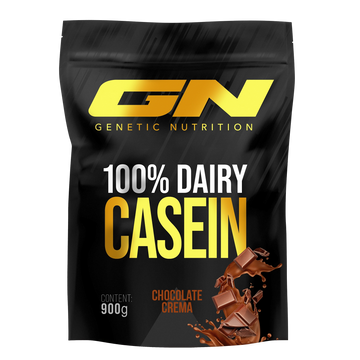
Product tip: Our favourite is the 100% Casein Protein by GN Laboratories (900 g, 30 servings): micellar casein, made in Germany, customer rating 4.89 out of 5. In the last 90 days we shipped 156 tubs, 62 % of them from GN Laboratories (as of August 2026). You will find all flavours and brands in the casein protein overview.
Cheese without casein: is there casein-free cheese?
No, there is no cheese without casein made from animal milk. Cheese is made by curdling casein so that it separates from the whey as curd; the curd is therefore concentrated casein. This applies to all cheese types, for cow's milk as much as for goat's, sheep's and buffalo milk, and also to any vegan cheese that has milk protein added. Goat's and sheep's milk do have a slightly different casein composition (less alpha-s1 casein)10, but they are not casein-free, and with a cow's milk allergy most people also react to the caseins of goat and sheep9. With a milk protein allergy, goat's cheese is therefore not an alternative.
Three misunderstandings that often lead to cheese that does not fit at all:
Lactose-free is not casein-free. Lactose-free cheese and lactose-free milk contain the full amount of casein; only the milk sugar has been broken down. Ripened hard cheese such as Emmental or alpine cheese is naturally almost lactose-free but especially rich in casein. That helps with lactose intolerance, not with a milk protein allergy, because there the body reacts to the protein itself and not to the milk sugar.
A2 milk is not casein-free. A2 milk contains just as much casein as regular milk, only in the beta-casein variant A2 instead of A18. Beta-casein is one of four casein types in cow's milk; with a casein intolerance or milk allergy, A2 milk is therefore not an alternative, and it does not help with lactose intolerance either, because the milk sugar is fully present.
Casein-free cheese is always plant-based. A vegan alternative based on cashew, almond, soy, coconut oil or oats contains no casein. Check the ingredient list to make sure no milk protein or caseinate has been added; some melting products still contain such milk ingredients.
People who have to avoid casein use the overview above as an avoid list and go for plant-based products when it comes to protein powder; we stock vegan protein powders separately from the milk proteins. How a casein intolerance shows itself, which symptoms are typical and which test distinguishes it from lactose intolerance is covered in the guide Casein intolerance: symptoms, test and what you can eat.
Does butter contain much casein?
Not much: butter contains 0.85 g of protein per 100 g2 and therefore under 1 g of casein, because it consists of milk fat and the protein stays behind in the buttermilk when churning. Clarified butter and ghee are clarified even further and contain practically no casein at all. For your protein intake, butter plays no role; for people with a milk allergy the traces remain relevant, because even small amounts of milk protein can trigger a reaction. Margarine is only casein-free if no milk ingredients have been added.
Casein in yoghurt, skyr and milk
With fermented dairy products, little changes for the casein: natural yoghurt contains around 3.5 g of protein per 100 g, of which about 2.8 g is casein, practically as much as the milk it was made from2. Fermentation changes the milk sugar and the texture, not the casein content. That is why many people with lactose intolerance tolerate yoghurt better than milk, although both dairy products contain the same amount of casein. Greek yoghurt and skyr are strained and therefore denser: Greek yoghurt comes to about 7 g of casein, skyr to just under 9 g per 100 g2,3. Strictly speaking, skyr is a fresh cheese and in casein content sits closer to quark than to yoghurt.
Cow's milk itself delivers 2.6 to 2.7 g of casein per 100 ml regardless of fat level, because whole milk and low-fat milk differ in fat content, hardly in protein2. Kefir and buttermilk are on a par with milk. Milk powder is dried milk and correspondingly concentrated, while cream is high in fat and low in protein. The protein content of goat's and sheep's milk is on the level of cow's milk or above it, with the same casein share10. For your everyday life that means: all dairy products in the chiller cabinet deliver casein; the only question is how concentrated.
Who the casein table matters for
Athletes training for muscle growth use the overview when planning their meals, above all for the last meal of the day. Casein is digested more slowly in the body than whey protein; the slow digestion keeps the level of amino acids in the blood high for several hours4. In studies with 27.5 to 40 g of casein before sleep, overnight muscle protein synthesis increased5. Over twelve weeks of strength training, the gain in muscle mass and strength was higher with the evening protein than with placebo6,7. Protein contributes to a growth in and maintenance of muscle mass11; the values above show you whether you cover that serving with quark, skyr or a shake. The timing is explained in the guide Is casein before sleep worthwhile?
Anyone watching calories in their diet, whether dieting or competing in a sport with weight classes, compares protein against calories: low-fat quark, skyr and cottage cheese deliver a lot of casein with little fat, hard cheese delivers the most per 100 g but with 26 to 30 g of fat. A casein shake sits at the lower end with 104 to 118 kcal per serving3.
With casein intolerance or a cow's milk allergy the logic flips: the list becomes an avoid list, and the hidden sources from the first section make the ingredient list daily required reading. Whether lactose or milk protein is behind complaints after dairy products is clarified by a test at the doctor's. The difference between allergy, intolerance and lactose intolerance, the typical symptoms and what those affected can eat instead are explained in the guide on casein intolerance. What casein is chemically and how micellar casein, caseinate and hydrolysate differ is covered in the basics article What is casein?; the comparison of the two milk proteins can be found under Whey or casein?
Conclusion: the table replaces guesswork
Milk delivers around 2.6 g of casein per 100 ml, quark and skyr 9 to 11 g, hard cheese over 30 g, butter almost nothing, and casein protein powder is the most concentrated form with 74 to 82 g of protein per 100 g. Foods without milk contain no casein. With the 80 percent rule you can convert any dairy product yourself that is not listed here. For your daily evening serving, two routes lead to the goal: a tub of low-fat quark or a shake with 30 g of micellar casein.

Our selection: In the casein protein overview we stock three brands with micellar casein. The bestseller is the 100% Casein Protein by GN Laboratories (73.6 to 81.8 g of protein per 100 g, made in Germany). Next to it is the Micellar Casein by PEAK (76 to 80 g of protein per 100 g, five flavours, with added lactase). The third tub is the 100% Casein by Stacker2 (75 to 79 g of protein per 100 g, 30 shakes per tub). All three products make a creamy shake for the night with 300 ml of water or milk; which one suits you comes down to your taste and your budget per 100 g of protein.
Frequently asked questions about casein in foods
Do eggs contain casein?
Does skyr contain casein?
Which food has the most casein?
Are milk protein and casein the same thing?
Does whey protein contain casein?
Is lactose-free milk casein-free?
Does goat's milk contain casein?
Sources
- Haug A., Høstmark A. T., Harstad O. M., Lipids in Health and Disease (2007): Bovine milk in human nutrition, a review. pmc.ncbi.nlm.nih.gov/articles/PMC2039733/
- USDA FoodData Central (2026): SR Legacy: Eiweiß je 100 g (Milch FDC 171265 und 170872, Joghurt 171284 und 171304, Hüttenkäse 173417, Mozzarella 170845, Camembert 172178, Emmentaler-Typ 171251, Parmesan 170848, Butter 173410). fdc.nal.usda.gov/
- Herstellerangaben GN Laboratories, PEAK, Stacker2 (Nährwerttabellen) (2026): Eiweiß je 100 g und Energie je 30-g-Portion der Casein-Pulver (73,6 bis 81,8 g, 76 bis 80 g, 75 bis 79 g; 104 bis 118 kcal); Magerquark und Skyr natur nach Etikett. gigasnutrition.com/collections/casein-protein
- Boirie Y. et al., PNAS (1997): Slow and fast dietary proteins differently modulate postprandial protein accretion. pubmed.ncbi.nlm.nih.gov/9405716/
- Res P. T. et al., Medicine and Science in Sports and Exercise (2012): Protein ingestion before sleep improves postexercise overnight recovery. pubmed.ncbi.nlm.nih.gov/22330017/
- Snijders T. et al., Journal of Nutrition (2015): Protein ingestion before sleep increases muscle mass and strength gains during prolonged resistance-type exercise training in healthy young men. pubmed.ncbi.nlm.nih.gov/25926415/
- Trommelen J., van Loon L. J. C., Nutrients (2016): Pre-sleep protein ingestion to improve the skeletal muscle adaptive response to exercise training. pubmed.ncbi.nlm.nih.gov/27916799/
- Brooke-Taylor S. et al., Advances in Nutrition (2017): Systematic review of the gastrointestinal effects of A1 compared with A2 beta-casein. pmc.ncbi.nlm.nih.gov/articles/PMC5593102/
- Restani P. et al., Clinical and Experimental Allergy (1999): Cross-reactivity between milk proteins from different animal species. pubmed.ncbi.nlm.nih.gov/10383602/
- Clark S., Mora García M. B., Journal of Dairy Science (2017): A 100-Year Review: Advances in goat milk research. pubmed.ncbi.nlm.nih.gov/29153153/
- Europäische Kommission (2012): Verordnung (EU) Nr. 432/2012 (Liste zulässiger gesundheitsbezogener Angaben). eur-lex.europa.eu/eli/reg/2012/432/oj/eng