Carbohydrates during exercise: when and how much makes sense
Assess your workload and add up carbohydrates from drinks, gels and snacks.

Carbohydrates during exercise are particularly useful for longer, intense sessions. For a typical strength workout after a meal, water is often enough. Whether you train at the gym, run or cycle, this guide helps you assess your session and calculate how many carbohydrates you actually consume from drinks, gels and snacks.
Key takeaways
- Whether you need extra carbohydrates during exercise depends mainly on duration, intensity and the time since your last meal. Endurance recommendations cannot simply be applied to strength training at the gym.
- Add up the carbohydrates consumed from drinks, gels and snacks within the same hour. Your meal beforehand affects your starting point and daily intake, but is not part of the calculation for that hour of exercise.
- Always test new products, quantities and concentrations in training first, rather than on race day.
Does your session need extra carbohydrates?
Digestible carbohydrates provide glucose, among other components. Your body stores carbohydrates as glycogen in the muscles and liver. Your starting point, session duration and intensity all matter when planning fuel during exercise. There is no fixed minute at which everyone's stores run out.1
During short, maximal efforts, energy initially comes from existing ATP and phosphocreatine. Carbohydrate metabolism also contributes. It therefore makes more sense to assess your whole session than a single heavy set when deciding how much extra energy you may need.
Strength training after a meal
If you have eaten enough throughout the day and are doing a typical strength workout, you often do not need extra energy in your drink. Water may be sufficient. Assess your actual workload: a few heavy sets with long rests are different from many demanding sets in quick succession.2
Long, high-volume or fasted strength sessions
A review of 21 studies involving 226 participants, mostly men, found higher training volume after carbohydrate intake before and/or during resistance exercise. Stronger signals appeared in longer sessions and after a longer period without food, among other conditions.2
The studies examined different training protocols and short-term effects. They do not establish additional muscle growth over several months.2 In practice, very high numbers of demanding sets or a long gap since eating are reasons to plan your nutrition around training more carefully.
Longer, intense endurance exercise
During long, intense runs, bike rides or races, carbohydrate intake can help maintain performance.1 Plan it around duration, intensity and tolerance you have already tested. An easy recreational ride and a race lasting several hours do not need the same fuelling plan.
Your session at a glance
| Your situation | What to check first | Practical assessment |
|---|---|---|
| Typical strength training | Normal meals and adequate daily intake | Extra carbohydrates during the session are often unnecessary |
| Very high-volume or fasted strength training | Number of sets, time without food and previous intake | Plan nutrition individually; no universal gram-based formula |
| Long, intense endurance exercise | Duration, intensity and tolerance | Plan carbohydrate intake during exercise using the ranges below |
How many grams of carbohydrate per hour?
The DGE position paper gives the following guidance for intense endurance exercise. The longer and more demanding the session, the more important planned fuelling becomes.1
- Shorter, easy session: extra carbohydrates are often unnecessary.
- Intense endurance exercise lasting about 1 to 2.5 hours: 30 to 60 g of carbohydrate per hour.
- Very long exercise lasting about 2.5 to 3 hours or more: up to 90 g per hour may be appropriate, using different carbohydrate sources such as glucose and fructose, with tolerance tested beforehand.
These ranges do not translate into a rigid 30/60/90 g plan for strength training, because the patterns of exertion differ.
Do not start at the upper end just because you have seen a number. Choose a tolerable intake for your specific session and account for every source. The hourly ranges are not an instruction to exceed an individual product's recommended intake.
Grams per hour or per kilogram of body weight?
These are different measurements. Grams per hour here refer to intake during exercise. Grams per kilogram of body weight per day describe total daily intake, including meals and training drinks. The appropriate daily range depends on training volume and intensity.1 A whole day's recommendation does not belong in one shaker.
Drinks, gels and snacks: calculating the total
A drink and a gel are not independent recommendations. What matters is how many carbohydrates you actually consume within the same period.
Hypothetical calculation: according to its label, your sports drink provides 30 g of carbohydrate per serving, while a gel adds 25 g. Consuming both within the same hour gives you 55 g of carbohydrate per hour. This is not 55 g of powder: it is the sum of carbohydrates from all foods and products consumed in that period.
Follow these steps:
- Read the carbohydrate amount per serving on the label.
- Work out how much you actually consume. Half a bottle is only half a serving if the full bottle contains exactly one serving.
- Use the same time period for every item.
- Add the carbohydrates from every source.
If you mix two manufacturer-defined servings in one large bottle, half the bottle already contains a full serving. Note how much powder you add when mixing. Bottle size, number of servings and hourly intake are three different measurements.
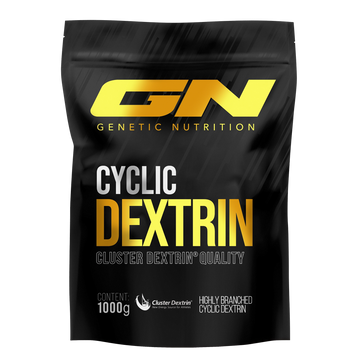
A product example from our range: GN Laboratories Cluster Dextrin contains approximately 58.2 g of carbohydrate per 60 g of powder, according to the manufacturer. The recommended preparation is 30 to 60 g of powder in 300 ml of water. This describes the recommended intake, rather than an instruction for everyone to drink one bottle per hour.

Which carbohydrate sources suit exercise?
Drinks, gels, bars or food
Liquid or gel-based carbohydrate sources can be convenient during intense exercise. During easier sections, solid foods such as bananas, rice cakes or carbohydrate-rich bars may also be suitable, depending on your sport. What matters is what you can carry, eat and tolerate. Larger amounts of fat and fibre during exercise can make digestion more difficult.1
Avoid simply dividing carbohydrates into good slow ones and bad fast ones. Longer carbohydrate chains can also be digested quickly. Wholegrains in everyday meals serve a different purpose from an easy-to-consume carbohydrate source during a long race.
For mixing your own drink, our range includes maltodextrin and cluster dextrin. Both provide glucose when digested. Compare carbohydrates per serving and preparation instructions. With ready-made intra-workout blends, also check what other ingredients are included.
Our comparison Maltodextrin or Cluster Dextrin helps you compare ingredient structure, label amounts and the cost of the same amount of carbohydrate.
Glucose and fructose at higher intakes
Glucose and fructose use different transport pathways in the gut. This may matter at high carbohydrate intakes during long endurance events.1 It does not mean that typical strength training requires a special sugar blend. Maltodextrin and cluster dextrin provide glucose units, so combining the two does not create a glucose-fructose mixture.
Test your mix and tolerance in training
Your water needs depend on you, the temperature and the workload. There is no universal number of millilitres per hour. Powder in your shaker does not replace your entire fluid intake.
Overly concentrated drinks or large single amounts can contribute to stomach problems. Follow the manufacturer's instructions and, when experimenting, change only one factor at a time if possible. If you experience discomfort, reduce the burden on your stomach rather than adding more servings.
Test new gels, drinks and quantities in normal training sessions. Record duration, intensity, temperature, fluid intake and any discomfort. This makes it easier to see whether a mix works in your specific situation. Race day should not be your first test.
Want to mix your own drink? Our guide to making your own intra-workout drink provides a basic recipe and explains how water, carbohydrates and other ingredients fit together.
What if you want to lose weight or build muscle?
Calories from your training drink count towards your daily intake too. If you want to lose weight, include them in your calorie deficit. For muscle building, carbohydrates provide energy, while protein provides the amino acids needed.4 A carbohydrate drink therefore does not replace adequate protein intake. Whether additional free amino acids suit your diet is explained in our EAA or BCAA comparison.
High carb and low carb describe different dietary approaches. When planning your training drink, the specific session is more useful than that label: include a serving where it suits your workload and account for it alongside your other meals.
Frequently asked questions
Should I wait until my energy drops before taking carbohydrates?
Do I also need electrolytes?
Do carbohydrates before exercise count towards the hourly amount?
Sources
- Deutsche Gesellschaft für Ernährung (DGE) (2019): Kohlenhydrate in der Sporternährung. dge.de/fileadmin/dok/gesunde-ernaehrung/gezielte-ern...
- King et al. (2022): The Ergogenic Effects of Acute Carbohydrate Feeding on Resistance Exercise Performance: A Systematic Review and Meta-analysis. link.springer.com/article/10.1007/s40279-022-01716-w
- Deutsche Gesellschaft für Ernährung (DGE) (2019): Flüssigkeitsmanagement im Sport. dge.de/fileadmin/dok/gesunde-ernaehrung/gezielte-ern...
- König et al. / DGE (2020): Proteinzufuhr im Sport. dge.de/fileadmin/dok/gesunde-ernaehrung/gezielte-ern...