


EAA or BCAA: What suits your diet and training?
Nine amino acids or three? Check your protein intake and compare the amounts on the label.

Whether EAA or BCAA suit you depends mainly on your existing protein intake. EAA contain all nine essential amino acids, while BCAA contain three of them. If you do strength training and are deciding between the two powders, this diet check and label example will help: you can see how the products differ and how many amino acids a serving actually provides.
Key points at a glance
- Nine versus three: EAA contain all nine essential amino acids. BCAA consist of three: leucine, isoleucine and valine. Every BCAA is also an EAA, but not the other way round.
- Diet first: High-quality protein sources such as whey already contain all essential amino acids. Check your daily protein intake before considering isolated amino acids.
- Powder weight ≠ amino acid content: The serving size on the label is not the same as the amount of EAA or BCAA it contains. Our label example shows you how to distinguish them.
- EAA and BCAA do not replace a complete meal: Neither provides a complete supply of micronutrients, fats or sufficient energy.
EAA and BCAA: nine amino acids or three?
Which amino acids belong to the EAA group?
EAA stands for Essential Amino Acids. We must obtain nine of these protein building blocks through our diet: histidine, isoleucine, leucine, lysine, methionine, phenylalanine, threonine, tryptophan and valine. They are among the 20 commonly listed proteinogenic amino acids that the body uses to build proteins.1
BCAA stands for Branched Chain Amino Acids: leucine, isoleucine and valine. They are a subset of EAA. A BCAA supplement therefore provides three essential amino acids, rather than the complete essential profile.2

What leucine explains, and what it does not
Muscle protein synthesis means building new proteins in your muscles. Leucine is involved in activating this process. However, the signal alone does not replace the other amino acids required. Signalling and a complete supply are therefore two different questions.2
A small study involving ten trained men found higher muscle protein synthesis after 5.6 g of BCAA than after a placebo. Measurements covered four hours, rather than muscle growth over months.2 Dismissing BCAA as ineffective therefore goes too far. However, this short-term response does not establish additional muscle growth in everyday training.
What about muscle soreness and recovery?
A 2024 meta-analysis involving 18 studies found, on average, less muscle soreness in the days after demanding exercise following BCAA intake. The results relate to specific intake and exercise protocols in healthy, active people.4 This is an interesting finding about recovery, but it is not a direct comparison with EAA: the analysis does not show that BCAA are superior to a complete amino acid profile.
EAA or BCAA: a direct comparison
| Feature | EAA | BCAA |
|---|---|---|
| Number of amino acids | Nine essential amino acids | Three: leucine, isoleucine and valine |
| Contains BCAA? | Yes, as a subset | Yes, these are the contents |
| Complete essential profile? | Yes | No |
| Concentration per serving | Depends on the product; check the label | Depends on the product; check the label |
| Replaces a complete meal? | No | No |
When comparing two products, check how many grams of free amino acids each serving provides and what that serving costs. Powder weight alone is not enough: flavourings and other ingredients also contribute to it. Check the individual product to find out which formula tastes good and suits you.
When a supplement fits your everyday diet
If you already eat enough protein
First, note the protein sources and portions you actually eat over a few typical days. If you regularly miss a meal or it contains very little protein, that is a starting point. The German Nutrition Society (DGE) puts a balanced diet first when it comes to protein intake; supplements can complement it depending on the situation.3
Quark, eggs, fish, pulses and soya products are examples of protein sources. Whey protein also provides all nine EAA. An amino acid powder is therefore another option, rather than a requirement for a protein-rich diet.1
Fasted training, dieting and plant-based eating
These three situations deserve a closer look:
Calorie deficit: When you eat less, check whether your protein intake also drops unintentionally. A supplement can contribute to your intake if it addresses a specific gap. EAA or BCAA alone do not guarantee muscle retention during a diet.3
Fasted training: Before an early session, your last meal may have been some time ago. Consider whether you want to eat beforehand or plan your first meal afterwards. Training time alone does not make either EAA or BCAA compulsory. Assess tolerance and convenience using the individual formula, rather than the abbreviation on the tub.
Plant-based eating: What matters is sufficient protein and a suitable combination of foods. Being vegan does not automatically mean an amino acid deficiency. The DGE explains that complementary plant protein sources can be combined across the day.3
EAA, BCAA or whey?
Whey is a complete protein that is broken down into smaller building blocks during digestion. EAA and BCAA products provide free amino acids. If you want to increase your daily protein intake, include foods and protein powders in your comparison. For a specific amount of free amino acids, use the declared amino acid profile instead.
A clear amino acid drink may suit your drinking routine better than a creamy protein shake. Compare flavour, ingredients and recommended water volume. The label also tells you how much you actually consume in a serving.
A scoop is not a standard unit of measurement. Powder amounts, amino acid content and directions for use vary. Compare the stated grams per serving before treating two products as equally dosed.
How to read an amino acid profile on the label
Powder weight and amino acid content are two different measurements. We will work through an example using a product from our range.
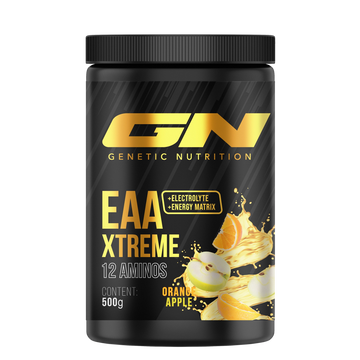
Take EAA Xtreme by GN Laboratories in the Waldmeister flavour. One serving is 20 g of powder and, according to the label, provides these free amino acids:
- Leucine: 3 g
- Isoleucine: 1.5 g
- Valine: 1.5 g
- Lysine: 1.5 g
- Threonine: 1 g
- Phenylalanine: 1 g
- Methionine: 0.5 g
- Tryptophan: 0.5 g
- Histidine: 0.5 g
Adding all nine gives a calculated total of 11 g of EAA per serving. Of this, 6 g comes from the three BCAA: leucine, isoleucine and valine. Histidine counts as an EAA even when a label lists it in a separate section; it is not added on top of the 11 g.
The nutrition table separately lists 9.6 g of protein. We do not use this value as a substitute for the sum of the individually declared free amino acids. The calculation uses the declared profile, rather than our own laboratory analysis. The 20 g serving also provides 55 kcal.
The directions for this variant are 20 g daily in 500 to 700 ml of water. The figures in this example relate to Waldmeister; check the label for any other flavour. Other ingredients also matter in a comparison: for example, this formula contains green coffee extract.
Three steps for checking the label:
- Start with the serving size in grams of powder.
- For an EAA product, add the nine listed amino acids.
- Count leucine, isoleucine and valine as part of that sum, rather than adding them again.
What does a BCAA ratio of 2:1:1 mean?
The numbers stand for leucine : isoleucine : valine. In our example, 3 g, 1.5 g and 1.5 g give exactly a 2:1:1 ratio. The ratio therefore describes the distribution, rather than the total amount. Compare grams per serving first; a larger number before the colon does not automatically make a product the better choice.
Which supplement suits you?
Choosing between EAA and BCAA ultimately depends on your diet and everyday training:
- Your diet already meets your protein needs: You do not need either EAA or BCAA as an automatic extra serving. Complete protein from food or whey already provides all amino acids.
- You want to supplement all nine essential amino acids in free form: Compare our EAA products by profile, grams per serving and other ingredients.
- You specifically want leucine, isoleucine and valine: Our BCAA products provide this subgroup. Check actual amounts and their ratio, without automatically assuming that a higher ratio is better.
Our selection rule: First decide what you want to supplement, then compare the suitable formula and its serving. A complete EAA profile is the clear difference from BCAA. Whether you need it in addition to your diet depends on what you already eat.
Are you considering your whole training drink rather than just amino acids? Our guide to choosing an intra-workout drink also covers carbohydrates, fluids and electrolytes.
Common questions about EAA and BCAA
Can I take EAA and BCAA together?
Are BCAA during exercise always useless?
When does taking EAA or BCAA make sense?
Sources
- Deutsche Gesellschaft für Ernährung (DGE): Fragen und Antworten zu Protein und unentbehrlichen Aminosäuren. dge.de/gesunde-ernaehrung/faq/ausgewaehlte-fragen-un...
- Jackman et al. (2017): Branched-Chain Amino Acid Ingestion Stimulates Muscle Myofibrillar Protein Synthesis following Resistance Exercise in Humans. frontiersin.org/journals/physiology/articles/10.3389...
- König et al., Deutsche Gesellschaft für Ernährung (DGE) (2020): Proteinzufuhr im Sport. dge.de/fileadmin/dok/gesunde-ernaehrung/gezielte-ern...
- Salem et al. (2024): Attenuating Muscle Damage Biomarkers and Muscle Soreness After an Exercise-Induced Muscle Damage with Branched-Chain Amino Acid (BCAA) Supplementation: A Systematic Review and Meta-analysis with Meta-regression.. pubmed.ncbi.nlm.nih.gov/38625669/


Leave a comment