


Maltodextrin or Cluster Dextrin: Which powder suits your training drink?
Compare two carbohydrate sources by amount, preparation, tolerance and cost for the same amount of carbohydrate.

Maltodextrin and Cluster Dextrin let you add carbohydrates to your training drink and provide your body with energy. They differ in their molecular structure and the properties of the drinks made from them. Which powder is worth choosing depends on carbohydrate content, tolerance and the current price. Here you can compare two products from our range and calculate how much carbohydrate you get for your money.
The key points
- Both powders are readily available carbohydrate sources that provide glucose during digestion. Neither is a fibre or a genuinely “slow” energy source.
- Their molecular structures differ. What this means for your drink also depends on its complete formula and concentration. It does not make either powder a universal performance winner.
- Compare grams of carbohydrate and the cost of the same amount, rather than the price of a tub or the powder weight alone. This reveals the actual difference in cost.
What distinguishes the two carbohydrates?
Maltodextrin: carbohydrates made from starch
Maltodextrin is made from starch. During hydrolysis, longer starch chains are partially broken down. The result is a mixture of glucose chains of different lengths, which may also contain branches. Digestible maltodextrin serves as a carbohydrate source in foods and sports drinks.1
The dextrose equivalent (DE) relates to the degree of starch breakdown. More precisely, it describes reducing power relative to glucose. It is not the glycaemic index: DE 6 does not mean a GI of 6. Digestible maltodextrin can raise blood glucose rapidly; a low DE number does not make it a slowly available carbohydrate source.1
Cluster Dextrin: highly branched cyclic dextrin
Cluster Dextrin is a branded ingredient for Highly Branched Cyclic Dextrin, or HBCD. It is produced enzymatically from starch and also supplies digestible carbohydrates. The name should not be confused with resistant dextrin, which is used as a fibre.
Its particular structure affects the properties of the dissolved powder. Both ingredients provide glucose during digestion. The division into “fast maltodextrin, slow Cluster Dextrin” is therefore too simplistic: larger molecules do not automatically mean a steady supply of energy over several hours.
How does dextrose differ?
Dextrose is glucose, a monosaccharide. Maltodextrin, by contrast, consists of chains of glucose units.1 For your drink, the amount in grams is therefore not the only consideration; the form in which the carbohydrates occur matters too. This affects the concentration of particles in the drink, which we discuss below.
Maltodextrin and Cluster Dextrin compared
The following table compares the main factors in your choice. The product values come from the current labels of our two carbohydrate powders.
| Feature | GN Maltodextrin DE6 | GN Cluster Dextrin |
|---|---|---|
| Ingredient | Maltodextrin DE6 | Highly branched cyclic dextrin |
| Carbohydrates on the label | 96 g per 100 g powder | 58.2 g per 60 g powder |
| Calculation for 30 g powder | 28.8 g carbohydrates | 29.1 g carbohydrates |
| Manufacturer’s preparation instructions | 30 g daily in 200 ml water | 30 to 60 g in 300 ml water |
| Price comparison | Convert the current pack price to the same amount of carbohydrate | |
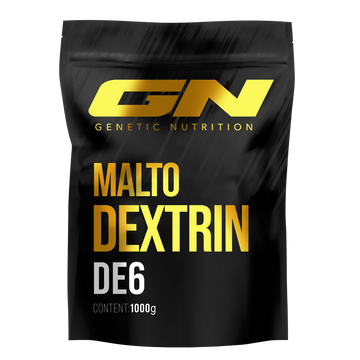
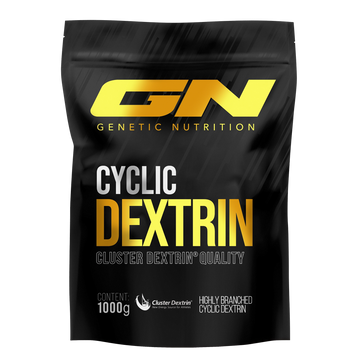
Thirty grams of powder provide a calculated 28.8 g and 29.1 g of carbohydrates, respectively. The maltodextrin label rounds the 30 g serving to 29 g. The difference of 0.3 g in this comparison does not explain a noticeable training advantage. You can find the products in our range as GN Maltodextrin DE6 and GN Cluster Dextrin.
This comparison uses 30 g of powder as a common calculation basis. It does not replace the directions for use or standardise the water quantities specified by the manufacturer.

How much carbohydrate do you get for your money?
Compare pack size, carbohydrate content and the current price together. A lower tub price may simply reflect a smaller pack. For a fair comparison, convert both offers to the same amount of carbohydrate.
To calculate the actual price per gram of carbohydrate, use:
Pack price ÷ (powder weight × carbohydrate fraction) = price per gram of carbohydrate
For example, take 1,000 g of each powder: 96% carbohydrate gives 960 g; 58.2 g per 60 g is 97%, giving 970 g. Divide the respective price for this amount of powder by 960 or 970. To calculate the cost of, for example, 30 g of carbohydrates, multiply the result by 30. This is a basis for comparing prices, rather than a new intake recommendation.
This reveals the actual premium. You can then weigh it against your use and tolerance, rather than assuming that a higher price means a better effect.
Osmolality and your stomach: what does the difference really tell you?
Osmolality describes the amount of osmotically active particles per kilogram of solvent. For the same carbohydrate mass, larger molecules generally mean fewer individual particles. However, the osmolality of your finished drink also depends on salt, other ingredients and concentration. Osmolarity is related, but refers to the volume of the solution.
Takii and colleagues studied gastric emptying of different 10% carbohydrate drinks in ten people. An HBCD mixture adjusted to 150 mOsm with other ingredients left the stomach faster than the dextrin solution tested, which had DE 16 and 269 mOsm.2 The study therefore provides evidence for that specific formula. It did not compare our two powders or assess tolerance in every training scenario. Faster gastric emptying alone also does not prove better sporting performance.
Carbohydrate amount, water and training conditions all matter for stomach tolerance. Follow the manufacturer’s preparation instructions and note what you actually drank. If you have stomach problems, avoid changing the powder, quantity, additional gel and training intensity all at once. Otherwise, it will be unclear what caused any change. Try new mixtures during normal training sessions first.
Which powder suits your training?
Before choosing between the two carbohydrate sources, first establish whether you need carbohydrates during exercise at all. A carbohydrate drink is often unnecessary for a typical strength workout after a meal. What matters is the volume and intensity of the actual exercise.
- Maltodextrin: Looking for a carbohydrate source for your own mixture? Compare cost per serving and preparation in our maltodextrin range. If your mixture suits your session and you tolerate it, a longer training duration alone is no reason to switch.
- Cluster Dextrin: If you would like to try a different ingredient structure, our Cluster Dextrin range provides the details to compare. Keep the carbohydrate amount and training conditions as similar as possible when testing it, so you can assess differences more clearly.
At high carbohydrate intakes during prolonged endurance exercise, a combination of glucose sources and fructose may be relevant because different absorption pathways are used.3 Maltodextrin and Cluster Dextrin, however, both provide glucose units. Combining these two powders is therefore not the same as combining glucose and fructose.
Three questions are enough to guide your choice: What amount of carbohydrate do you need for the planned exercise? Which mixture fits your drinking routine? What does the same amount of carbohydrate cost at the current price? These questions let you compare the products according to your use.
If you want to turn that into your own drink, our guide to making your own intra-workout drink provides a basic recipe and advice on choosing the right mixture.
Common questions
Can I mix maltodextrin and Cluster Dextrin?
Does “0 g sugar” mean the drink is carbohydrate-free?
Can I use maltodextrin after training too?
Sources
- Hofman et al. (2016): Nutrition, Health, and Regulatory Aspects of Digestible Maltodextrins. pubmed.ncbi.nlm.nih.gov/25674937/
- Takii et al. (2005): Fluids containing a highly branched cyclic dextrin influence the gastric emptying rate. pubmed.ncbi.nlm.nih.gov/15900642/
- DGE (2019): Kohlenhydrate in der Sporternährung. dge.de/fileadmin/dok/gesunde-ernaehrung/gezielte-ern...
Leave a comment