Whey Isolate: The Complete Guide to Benefits & Buying
Whey isolate delivers around 90% protein with very little lactose and fat. This guide explains the definition, CFM production, nutritional values, usage and the key buying criteria.

Whey isolate is the purest form of whey protein: additional filtration removes most of the fat and milk sugar, so that the dry matter often retains around 90% protein. This makes it a fast-absorbing, low-calorie protein powder that is especially popular during dieting and among people sensitive to lactose. This guide explains what isolate actually is, how it is made, what it contains, and what to look for when buying.
Key facts at a glance
- In its dry matter, whey isolate usually contains around 90% protein, significantly more than concentrate (often 70 to 80%).
- Thanks to filtration, isolate is very low in lactose and fat, making it an option for those with sensitive milk sugar tolerance.
- Protein contributes to a growth in muscle mass and to the maintenance of muscle mass.
- The DGE cites 0.8 g of protein per kilogram of body weight per day as the reference value for adults; according to professional societies, physically active people need more.
- Isolate comes in creamy (classic shake) and clear (refreshing drink) versions, plus plant-based alternatives.
What is whey isolate?
Whey isolate (whey protein isolate) is a protein powder made from whey, with most of the fat and lactose removed during production. What remains is a very pure protein concentrate with a typical protein content of around 90% in the dry matter. Whey is a by-product of cheese-making and provides all nine essential amino acids in a favorable distribution.
Protein powders come in three grades of purity. Concentrate is the basic form, with a protein content that varies widely by product, from around 35 to 80%, along with more milk sugar and fat. Isolate is filtered more thoroughly and usually reaches around 90%. Hydrolysate goes one step further: here, the protein chains are already partially broken down, which can speed up absorption, though it often tastes slightly bitter.
| Grade | Protein (dry matter) | Lactose & fat | Typical use |
|---|---|---|---|
| Concentrate | approx. 35-80% | higher | everyday all-round protein needs |
| Isolate | approx. 90% | very low | calorie-conscious, lactose-sensitive |
| Hydrolysate | approx. 90%+ | very low | fast absorption, often slightly bitter |
In short: every isolate is a whey protein, but not every whey protein is an isolate. If you value a particularly high protein content with few accompanying substances, you will quickly end up with isolate. You will find a detailed comparison in the section further down.
How is whey isolate made?
Whey isolate is produced through a multi-stage filtration process that gently separates whey from fat and milk sugar. The most common methods are micro- and ultrafiltration through fine membranes, along with cross-flow microfiltration (CFM), in which the whey flows parallel to the membrane. This keeps the protein largely intact while smaller molecules are separated out.
One point many labels stay silent about: whey is usually a by-product of cheese production. So-called native whey, on the other hand, is obtained directly from milk and is considered particularly clean and naturally low in lactose. Quality therefore depends not only on filtration but also on the raw material source.
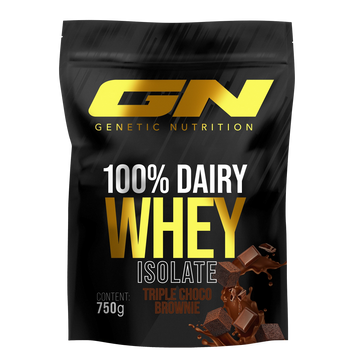
Why does the process matter? Because it determines purity. Purely temperature-based or chemical processing can put more strain on sensitive protein fractions. The CFM method, by contrast, works without heat and without acid and is therefore considered particularly gentle. The 100% Dairy Whey Isolate from GN Laboratories, for example, is produced using CFM.
The filtration also explains why isolate is low in fat and lactose: precisely these components are filtered out.
What are the nutritional values of whey isolate?
Whey isolate scores with a very high protein content and few accompanying calories: around 90% protein in the dry matter, plus very little fat and milk sugar. Depending on the product, a typical serving delivers about 22 to 27 g of protein. A single shake thus covers a noticeable share of your daily requirement.
Protein is not just a topic for athletes, it is a fundamental building block. Protein contributes to a growth in muscle mass and to the maintenance of muscle mass, and it contributes to the maintenance of normal bones.1 The prerequisite is that a food is at least a source of protein within the meaning of the regulation, which clearly applies to whey isolate.
Important for context: this effect applies to the protein itself, not as a healing promise of any individual product. Whey isolate is a food, not a medicine. You will always find the exact protein content per serving on the respective product page.
Which amino acids does whey isolate contain?
Whey isolate provides all nine essential amino acids, including a high proportion of branched-chain amino acids (BCAAs) with plenty of leucine. It is precisely this completeness that makes whey protein a protein with high biological value, in other words a protein your body can utilize particularly well.
The body cannot produce essential amino acids itself; they have to come from your diet. Whey naturally covers this profile well. The three BCAAs leucine, isoleucine and valine are a central component here, and leucine is considered an important building block in protein metabolism.
Why does this matter? Because it is not just the amount of protein that counts, but also the quality. A complete amino acid profile is the foundation that allows proteins to fulfill their function. A top-rated isolate comes with this complete profile; the exact values are listed on each product page.
Whey isolate or concentrate: what is the difference?
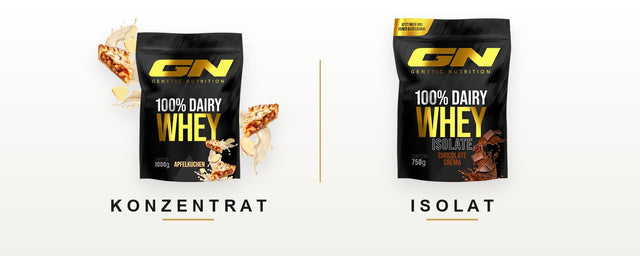
The main difference lies in purity: isolate is filtered more thoroughly, contains more protein per gram, and has less lactose and fat than concentrate. Concentrate, in turn, often tastes a little creamier and costs less per kilo. Both are high-quality protein sources; they simply serve different priorities.
A practical note: the name alone says little. A concentrate can contain anywhere from around 35 to 80% protein, so it pays to look at the protein content per 100 g rather than the word on the front of the tub. Also be careful with blends that list isolate among the ingredients but only add a small amount of it.
When is which worth it? Isolate is the first choice when maximum protein content, few calories and good tolerability matter, for example in a calorie-conscious phase or if you are sensitive to milk sugar. Concentrate is a solid all-round solution for daily protein needs when price per serving is the priority.
In practice, many people combine both: concentrate as the base, isolate specifically when purity is required.
Who is whey isolate suitable for?
Whey isolate is suitable for anyone who wants to meet their protein needs deliberately and with few calories, especially physically active people, those in a dieting phase, and people with sensitive lactose tolerance. Since most of the milk sugar is removed during filtration, many tolerate isolate better than a classic concentrate.
How much protein makes sense? The German Nutrition Society (DGE) cites a reference value of 0.8 g of protein per kilogram of body weight per day for adults between 19 and 65.2 For a reference weight, this corresponds to roughly 57 to 67 g per day.
Physically active people have higher requirements. Sports science societies cite a range of 1.4 to 2.0 g of protein per kilogram of body weight per day to build and maintain muscle mass.3 Whey isolate is a practical building block here that fits easily into your day, complementing a protein-rich diet based on whole foods.
Whey isolate for dieting: why the pure form fits
In a calorie-conscious phase, whey isolate scores with plenty of protein and little fat and sugar. This lets you meet your protein needs without taking in many extra calories. That is exactly why isolate is so popular during a diet: maximum protein density per calorie.
Protein is also very satiating and helps bridge longer gaps between meals. With reduced energy intake, your muscles are a concern too, because protein contributes to the maintenance of muscle mass. Sufficient protein intake is therefore a sensible companion when you are cutting calories.
A powder alone obviously does not make a diet; what matters is your overall nutrition and a negative calorie balance. Whey isolate is a tool that helps you keep your protein intake high without blowing your calorie budget. You will find a selection of pure isolates in the Whey Protein Isolate category.
Creamy or clear: which forms are available?

Whey isolate comes in two characters: creamy as a classic milkshake and clear as a light, fruity protein drink. Both deliver high-quality isolate; the difference lies in consistency and drinking experience. Creamy versions are more filling, clear drinks feel refreshing and sit lightly in the stomach.
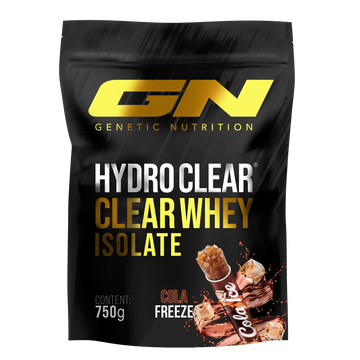
The creamy camp is covered by the 100% Dairy Whey Isolate from GN Laboratories, which keeps a smooth shake consistency despite its high purity. If you prefer it light, go for clear isolates such as the GN Hydro Clear Whey Isolate or the Viking Clear Isolate from Gods Rage, which drink more like a refreshing soft drink.
Clear isolates are especially popular in hot weather and after intense sessions, when a heavy milkshake would feel too rich. And if you avoid animal sources entirely, you will also find plant-based protein isolates as an alternative.
What should you look for when buying whey isolate?
Five criteria matter when buying: protein content, purity, solubility, taste and verifiable quality. A good isolate delivers a high protein value per serving, little sugar and fat, dissolves without clumps, and tastes good enough that you enjoy drinking it every day. Taste may sound like a side issue, but it decides whether a product actually gets used in everyday life.
What we place particular value on in our shop: traceable origin and testing. One of our most popular isolates, the one from GN Laboratories, is independently lab-tested, and its nutritional values are listed transparently on the product page. Also pay attention to the amino acid distribution, because a complete profile with all essential amino acids is the basis of a high-quality protein.
You do not have to choose between purity and taste; good isolates offer both. You will find a curated selection in our Whey Protein Isolate category.
Expert knowledge: how to recognize a high-quality whey isolate
You do not recognize a high-quality whey isolate by the biggest number on the front, but by three things: a gentle production process, an honest ingredient list without amino spiking, and an openly published amino acid profile with a lab analysis. It is exactly these points that separate a true premium isolate from mere label cosmetics.
What is amino spiking, and how do you spot it?
Amino spiking, also known as nitrogen spiking, describes the trick of adding cheap free amino acids such as glycine or taurine to a powder in order to artificially inflate the protein value determined by nitrogen testing. On paper, the product looks protein-rich, but the actual whey content is lower.
You can spot it in two places: the ingredient list and the amino acid profile. If individual free amino acids appear there as additives, a second look is worthwhile. The 100% Dairy Whey Isolate from GN Laboratories uses whey protein isolate as its sole protein source, without added free amino acids, and openly publishes the complete amino acid profile on the product page.
Why the process says more than the percentage
A high protein content alone is no proof of quality, because the way it is achieved counts too. Some isolates are produced via ion exchange, which delivers high values but can put more strain on the protein. Cross-flow microfiltration, by contrast, works cold and without acid, preserving the natural protein fractions. The isolate from GN Laboratories relies on exactly this process.
What "lab-tested" really means
Lab-tested is only a real argument if the testing is independent and verifiable. The GN isolate is analyzed by an accredited food laboratory, including microbiological testing: pathogens such as salmonella and E. coli are not detectable, and the microbial count is below the detection limit. A downloadable analysis on the product page makes this transparent.
Low in lactose does not automatically mean lactose-free
Whey isolate is very low in lactose thanks to filtration; in the 100% Dairy Whey Isolate from GN Laboratories, the value is below 1 percent. For many people with sensitive digestion this is welcome, but it does not necessarily mean zero milk sugar. If you have to avoid lactose completely, you are better off checking the exact value on the respective product page instead of relying on a generic label. And one more honest note: not every intolerance is caused by lactose. Some people react to the milk proteins themselves, such as casein; in that case, even a low-lactose isolate will not help, because it removes the milk sugar but not the proteins.
How do you use whey isolate correctly?
Depending on the product, one serving of whey isolate is usually 25 to 30 g of powder mixed into water or milk. Water keeps the shake light and low in calories; milk makes it creamier and adds extra protein. A shaker or a quick stir with a spoon is enough, as isolate generally dissolves very well.
When is the best time? Practically whenever you need a fast, high-quality protein source, for example after training, at breakfast, or as a snack in between. What matters most for success is not exact timing but the total amount of protein over the day. Isolate helps you reach that amount without hassle.
A practical everyday tip: if you are short on time in the morning, mix your shake the evening before and keep it chilled. That way you start the day protein-rich with zero effort.
Conclusion
Whey isolate is the pure, protein-rich and well-tolerated form of whey protein: around 90% protein, very little lactose and fat, quickly available. It suits physically active people, calorie-conscious phases, and anyone who does not tolerate milk sugar well. Whether creamy or clear, classic whey isolate or a plant-based alternative, you will find the right form in our Whey Protein Isolate category. If you want to dig deeper, the other guides in this series on comparison, drink varieties and production will help you further.
Frequently asked questions about whey isolate
Is whey isolate lactose-free?
Whey isolate or concentrate: which is better?
How much whey isolate per day makes sense?
Does whey isolate help build muscle?
Does whey isolate taste different from regular whey?
Sources
- Europäische Kommission (2012): Verordnung (EU) Nr. 432/2012 (Liste zulässiger gesundheitsbezogener Angaben). eur-lex.europa.eu/eli/reg/2012/432/oj/eng
- Deutsche Gesellschaft für Ernährung (DGE) (2017): Wie viel Protein brauchen wir?. dge.de/presse/meldungen/2011-2018/wie-viel-protein-b...
- Journal of the International Society of Sports Nutrition (Jäger et al.) (2017): Position Stand: Protein and Exercise. pmc.ncbi.nlm.nih.gov/articles/PMC5477153/
More on choosing your protein
-
Whey Concentrate vs Isolate: Which Suits You?
A comparison of concentrate, isolate and clear whey.
Read article -
Whey Isolate Test: How to Spot a Good Isolate
Which details help you compare whey isolates.
Read article -

CFM Whey Isolate: Cross-Flow Microfiltration Simply Explained
What cross-flow microfiltration means.
Read article