CFM Whey Isolate: Cross-Flow Microfiltration Simply Explained
CFM is printed on many isolate tubs, yet the term is rarely explained. CFM stands for cross-flow microfiltration, a gentle process that filters whey cold and without acid, yielding a protein powder with over 90% protein.

CFM is printed on many isolate tubs, yet the term itself is almost never explained. CFM stands for cross-flow microfiltration, a gentle process that filters whey cold and without acid, yielding a protein powder with over 90% protein. This guide explains simply what CFM is, how it works, how it differs from ion exchange and how to tell whether real quality sits behind the abbreviation.
The key points in brief
- CFM stands for cross-flow microfiltration, a membrane process, not for the airflow unit of the same name.
- The whey flows parallel to the membrane, cold and without acid, which keeps the membrane clean and preserves the natural whey fractions.
- CFM is a process, not a fixed level of purity: depending on how far it is taken, it produces a concentrate or an isolate with over 90% protein.
- Compared with ion exchange, CFM works more gently because it needs no heat and no acidic chemistry.
- CFM is a quality indicator, not a miracle: what counts in the end is the total amount of protein across the day.
What is CFM whey isolate?
CFM whey isolate, also sold as CFM whey protein isolate, whey protein CFM or CFM whey isolate, is a whey protein isolate obtained through cross-flow microfiltration, a purely mechanical membrane process without heat and without acid. Because nothing is heated, the powder counts as cold-processed. The result is a very pure protein powder with usually over 90% protein in the dry matter, with very little fat and milk sugar.
One quick clarification up front, because the abbreviation has two meanings: with protein powder, CFM always stands for cross-flow microfiltration, not for the airflow unit "cubic feet per minute" from ventilation engineering. The powder has nothing to do with airflow or cubic metres per hour; what is meant is purely the filtration method.
What fundamentally sets an isolate apart from a concentrate, and why the protein share per 100 grams matters more than the word on the front, we cover in detail in the Whey Isolate Guide. Here we focus on the step before that: the process that turns liquid whey into a pure powder.
How does cross-flow microfiltration work?
In cross-flow microfiltration, the liquid whey flows parallel along a very fine membrane instead of being pressed straight through it. The small molecules such as water, milk sugar and part of the minerals pass through the membrane, while the larger protein molecules are held back and concentrated.
The trick sits in the word "cross-flow". Because the liquid flows past sideways and is not pushed directly through the membrane, the stream continuously rinses the membrane surface clear. It clogs more slowly, and the process manages without aggressive aids. Filtration happens cold, without having to heat, and without acid or lye.
That is exactly the core: cross-flow microfiltration is a physical sieve on a molecular level. It separates by size, not by heat or chemical reactions, and therefore belongs to the same family of processes as micro- and ultrafiltration through fine membranes. This is why a powder obtained through CFM protein is regarded as especially gentle on the whey. That the filtration also removes fat and milk sugar explains, in passing, why an isolate turns out low in fat and lactose.
CFM or ion exchange: what is the difference?
The difference lies in the separation principle: CFM separates the protein purely mechanically through a membrane, whereas ion exchange uses the electric charge of the proteins and needs acid and lye to do so. Both reach high protein values, but they get there in very different ways.
With ion exchange, the whey is chemically adjusted so that the proteins bind to a carrier material and later detach again. This often pushes the protein value especially high, but it changes the composition: some of the naturally present whey fractions tend to be lost, and the process stresses the protein more than a cold membrane filtration.
The overview below compares the two processes. Important for context: "gentler" does not mean that a protein obtained through ion exchange would be worthless. It means that CFM keeps the natural whey closer to its original state.
| Feature | CFM (cross-flow microfiltration) | Ion exchange |
|---|---|---|
| Separation principle | mechanical, by molecule size through a membrane | chemical, via the electric charge of the proteins |
| Temperature | cold, without heating | involves heat |
| Aids | without acid or lye | with acid and lye |
| Protein content | usually over 90% | very high, often somewhat higher |
| Whey fractions | largely preserved | partly altered |
In the Whey Isolate Guide and in the comparison Whey Protein vs. Isolate we place the process within the bigger question of concentrate versus isolate. Here the rule of thumb is enough: CFM stands for the cold, mechanical route, ion exchange for the chemical one.
Is CFM a level of purity or a process?
CFM is a process, not a fixed level of purity. This is a common misunderstanding: cross-flow microfiltration describes how the filtering is done, not necessarily how pure the final product turns out. Depending on how far the process is taken, it produces a concentrate or an isolate.
In concrete terms: "CFM" on the tub is at first only a hint about the filtration method. A concentrate made by CFM sits well below an isolate made by CFM in protein content. Only the combination of process and filtration depth gives the actual protein value.
That is why a second look pays off: anyone who wants a pure isolate should not just watch for the abbreviation, but for the stated protein share per 100 grams. CFM says something about the quality of the route; the purity itself is in the nutrition table.
Does processing destroy the protein?
No, the processing does not make the protein worthless. In communities the worry persists that heavy processing "denatures" the protein and makes it inferior. Denaturation does change the spatial folding of the proteins, but the amino acids they contain remain intact.
For nutrition it is exactly these amino acids that matter. Protein is broken down into its building blocks in the body anyway; whether the original folding was intact or not makes little difference for how it is used. The common picture of "broken versus intact" therefore falls short.
Even so, gentle processing is a genuine argument, just for a different reason: because CFM works cold and without acid, more of the natural whey fractions stay in their original state. It is less about "destroyed or not" and more about how close the powder stays to natural whey.
What does CFM whey isolate offer in practice?
In practice CFM brings three things: preserved whey fractions thanks to the cold filtration, usually very good solubility, and a low milk-sugar content. That makes a CFM isolate a pure, well-tolerated, everyday-friendly protein powder.
Because the membrane separates by size and not by heat or acid, the composition of the whey stays closer to the natural original. Well-processed isolates also usually dissolve without lumps and mix quickly, which is worth more in daily use than it sounds. And thanks to the filtration an isolate is very low in lactose; in the example further below the value sits under one percent. Very low in lactose is, however, not the same as lactose-free, and not every intolerance is down to milk sugar; the details are in the Whey Isolate Guide.
One point should be named honestly: the process is only half the story. The raw material source of the whey also counts for quality, more on that in the pillar section about native whey. CFM does not make a good starting material better, it only preserves it more gently.
Expert knowledge: how to use CFM as a quality indicator
CFM is a useful quality signal, but not a seal of approval on its own. The abbreviation tells you that the whey was filtered gently and without acid. It does not replace a look at the ingredient list, the amino acid profile and lab testing. Only these three points together separate a genuine premium isolate from mere label optics.
Why this matters: especially with very cheap isolates, communities keep raising the suspicion of whether the powder really contains what the label says. A traceable process such as CFM is a first trust signal, provided the manufacturer proves it and keeps the remaining values transparent.
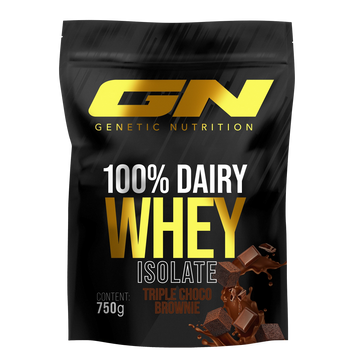
A concrete example from our own range is the 100% Dairy Whey Isolate by GN Laboratories. It is made by cross-flow microfiltration, that is cold and without ion exchange. The only protein source is whey protein isolate, with no added free amino acids, and the full amino acid profile is published openly on the product page. What lies behind the trick of added free amino acids, so-called amino spiking, we explain in detail in the Whey Isolate Guide.
So here is how to read the abbreviation correctly: CFM is the first filter, not the last. On top of it, watch for the protein content per 100 grams, an openly published amino acid profile and an accessible report from an independent lab. Anyone who wants to compare several pure isolates side by side will find guidance in our Whey Isolate Test.
Is CFM whey isolate worth it for you?
CFM whey isolate is worth it above all if purity, good tolerability and a gently processed protein matter to you. Anyone who is only after the largest possible amount of protein per euro is often better off with a solid concentrate or a blend, with no practical drawback for building muscle.
Important for expectations: protein contributes to a growth in muscle mass and to the maintenance of muscle mass.1 This effect applies to the protein itself, not as a promise of a particular process. CFM therefore does not make the protein "more effective", it only delivers it in a particularly pure and gently processed form. What counts in the end is the total amount of protein across the day, not the abbreviation on the tub.
How much protein makes sense can be read from neutral recommendations: the German Nutrition Society (DGE) states 0.8 g of protein per kilogram of body weight per day for adults as a reference value, with physically active people higher according to expert bodies.2 A CFM isolate is a practical building block here for reaching that amount easily. A curated selection of pure isolates can be found in our Whey Protein Isolate category.
Frequently Asked Questions about CFM Whey Isolate
What does CFM mean with whey protein?
What is the difference between whey isolate and CFM whey protein?
Is CFM whey better than whey obtained through ion exchange?
Is CFM whey isolate lactose-free?
How do I recognise a high-quality CFM whey isolate?
Sources
- Europäische Kommission (2012): Verordnung (EU) Nr. 432/2012 (Liste zulässiger gesundheitsbezogener Angaben). eur-lex.europa.eu/eli/reg/2012/432/oj/eng
- Deutsche Gesellschaft für Ernährung (DGE): Referenzwerte Protein. dge.de/wissenschaft/referenzwerte/protein/