


Vitamin D in winter: sunlight, diet and supplements
What sunlight and food contribute in winter, when it makes sense to have your status checked and how to read dose and intake days on the label.

In the German winter, the sun’s UVB radiation is usually not enough for adequate vitamin D production. Whether you need additional vitamin D, however, depends on your supply and your personal situation. The calendar alone is not an intake plan. Here you will learn what sunlight and food contribute, when it makes sense to have your status checked and what to look for in supplements.
The key points
- According to the German Nutrition Society (DGE), UVB radiation in Germany from October to March is not enough for adequate vitamin D production. A sunny winter day is no proof of a full reserve.
- Oily fish, egg yolk and certain edible mushrooms contribute to your supply, but usually do not cover the requirement on their own when the body cannot produce vitamin D itself.
- For adults, the DGE states 20 µg (800 IU) per day as an estimated value for total intake when the body’s own production is lacking, not as a general extra dose.
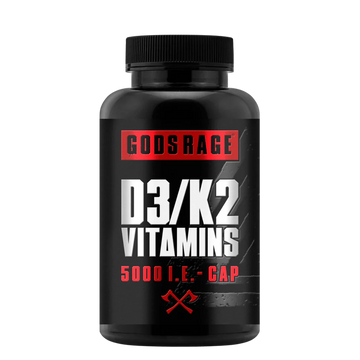
- A high-dose product such as the GN example shown, with 5,000 IU every third day, is intended only for use on medical advice. Do not put together high single doses yourself.
Why winter sun does not work like summer sun

You go to work in the dark, train in the gym in the evening and finally get outside for a run at the weekend. The question of vitamin D is an obvious one. What matters, however, is not only how bright it is outside: the body needs UVB radiation to produce vitamin D in the skin.
According to the German Nutrition Society (DGE), this radiation in Germany is not sufficient for adequate vitamin D production from October to March. A sunny day in December is therefore no proof of a well-filled vitamin D reserve. Pleasant temperatures say little about it either.1
The body can store vitamin D made in summer in fat and muscle tissue and use it in winter. How long these reserves last varies from person to person. A fixed promise such as “my summer holiday will last the whole winter” cannot be derived from this.1
For your training routine, this means: keep going outside when it suits your training. But do not count your running minutes as a vitamin D dose. And do not skip necessary sun protection to force production.
What your diet can contribute
Oily fish such as herring, salmon and mackerel contains vitamin D. Egg yolk and certain edible mushrooms also provide smaller amounts. A normal diet contributes to your supply, but usually does not cover the requirement on its own when the body cannot produce vitamin D itself.2
This makes these foods neither a therapy nor superfluous. If you eat fish, it can be part of your normal meals. A breakfast with eggs, however, does not prove that your vitamin D level is adequate. And if you do not eat fish, you do not need to try to make up for it with huge portions of eggs.
Fortified foods: what to look for
With fortified foods, it is worth looking at the pack: Has vitamin D been added, and what amount per serving is stated? Especially with plant-based alternatives, do not infer fortification from the product name. A food diary shows you what you take in; it does not measure your actual vitamin D status.
Who should have their vitamin D status checked
People who rarely spend time outdoors or largely cover their skin, among others, have an increased risk of an inadequate supply. Darker skin and older age can also limit the body’s own production. If this applies to you, an individual assessment is worthwhile, especially if little sun reached your skin even in summer.3
Tiredness or a weak training week is not a vitamin D diagnosis. Such complaints can have many causes. Have persistent complaints checked instead of deriving a high-dose course from them yourself.
Do I need a blood test for this?
Not automatically. Whether a blood test makes sense depends on a justified suspicion and your risk factors. In a medical assessment, the usual measurement is 25-hydroxyvitamin D, 25(OH)D for short. This is a blood value used to assess your supply. The season and the measuring method used also play a part in the interpretation.3,4
A short inventory helps for the conversation: which supplements do you already take, what amount do they contain and on which days do you take them? Bring the packs or photos of the labels. Existing conditions or regular medication also belong in the discussion.
What do 20 µg or 800 IU mean?
For adults, the DGE states 20 µg of vitamin D per day as an estimated value for an adequate intake when the body’s own production is lacking. This corresponds to 800 international units, IU for short.2
This refers to total intake. It is not a general instruction to take another 800 IU on top of food and supplements you already use. Nor is the value a treatment plan for a diagnosed deficiency.
The distinction matters when comparing products: an amount can refer to one capsule, one drop or one recommended serving. Only together with the intake frequency does the figure make sense. The biggest number on the tub is therefore not a sensible yardstick for your choice.
Vitamin D supplements: first the need, then the label
A supplement can make sense if your supply is not sufficient. Which amount and form suit you depends on your situation. If a supplement is intended for you, you can compare different forms and doses in our range of vitamin D3 and K2 supplements.
The GN label as a concrete example
The Vitamin D3 K2 capsules from GN Laboratories contain 125 µg of vitamin D3 per capsule, equivalent to 5,000 IU, plus 200 µg of vitamin K2. The recommended intake is: one capsule every third day with sufficient liquid.
This high-dose product should only be used on medical advice and under medical supervision. It is not a standard recommendation for everyone who trains in winter. According to the product information, it is not recommended for children or for pregnant or breastfeeding women.
You are reading three different pieces of information here: the content of one capsule, the intake days and the condition for use. None of them replaces the others. Also check whether your multivitamin, for example, already contains vitamin D. A photo of all labels is more helpful for this than remembering “I only take a few vitamins”.
Do not put together high single doses yourself
The German Federal Institute for Risk Assessment (BfR) warns against self-administered high single doses of vitamin D at intervals of days or weeks. A calculated average amount does not prove that a self-made interval scheme is safe. Nor is there evidence that vitamin K2 protects against a vitamin D overdose.5
If you take coumarin-type anticoagulants such as phenprocoumon, clarify vitamin K-containing supplements with your treating practice. Vitamin K can weaken their effect. Do not change the medication or your intake scheme on your own.5
Frequently asked questions about vitamin D in winter
How long do I need to be in the sun in winter?
Is a solarium an alternative?
Sources
- Deutsche Gesellschaft für Ernährung (DGE): Fragen und Antworten zu Vitamin D. dge.de/gesunde-ernaehrung/faq/vitamin-d/
- Deutsche Gesellschaft für Ernährung (DGE): Referenzwerte für Vitamin D. dge.de/wissenschaft/referenzwerte/vitamin-d/
- Bundesinstitut für Risikobewertung (BfR) (2025): Vitamin D – Sonne und Bewegung fördern eine gute Versorgung. bfr.bund.de/veroeffentlichung/ausgewaehlte-fragen-un...
- Institut für Qualität und Wirtschaftlichkeit im Gesundheitswesen (IQWiG) (2023): Vitamin-D-Mangel. gesundheitsinformation.de/vitamin-d-mangel.html
- Bundesinstitut für Risikobewertung (BfR) (2025): Einnahme hoher Einzeldosen Vitamin D über Nahrungsergänzungsmittel im Abstand von Tagen oder Wochen birgt gesundheitliche Risiken. bfr.bund.de/stellungnahme/einnahme-hoher-einzeldosen...
Further reading
-
 Image: AI-generated
Omega-3 dosage: how much per day and what counts on the label?
How to read EPA and DHA on the label and put the omega-3 reference value in context.
Read article -
 Image: AI-generated
Magnesium for athletes: when your diet is enough and when a supplement makes sense
Needs, foods, cramps and the magnesium content on the label, put into context.
Read article

Leave a comment