


Vitamin D without K2: is the combination always necessary?
Why vitamin D does not automatically need a K2 supplement, what studies on the combination show and what to watch for with anticoagulants.

If you take vitamin D, you do not automatically need an additional vitamin K2 supplement. Vitamin K is important for the body, but that does not mean everyone has to take a K2 capsule. What matters is your overall supply, the intended amount of vitamin D and any medication you take. Regular training does not make the combination necessary by itself either.
The key points
- If you take vitamin D, you do not automatically need an additional K2 supplement. Even without a K2 capsule, you still take in vitamin K from food.
- The BfR describes the existing studies on the combination as limited. A 2026 analysis found no statistically significant influence of vitamin K status on the effect of vitamin D on the markers examined.
- K2 does not automatically make a high vitamin D dose safe. Do not combine daily amounts into large weekly or monthly doses on your own.
- If you take coumarin-type anticoagulants, discuss supplements containing vitamin K with your doctor’s practice beforehand.
Vitamin D and vitamin K: a link does not mean you must combine them

Vitamin D contributes to the normal absorption and utilisation of calcium. Vitamin K is needed, among other things, so that certain proteins involved in blood clotting and bone metabolism can do their job. Both vitamins therefore have important functions. That alone, however, does not prove an additional benefit of a combination supplement for every adult.1,3
The key distinction is this: vitamin D without an additional K2 capsule is not the same as a diet without vitamin K. If you use a D3 supplement without K2, you still take in vitamin K from food. Whether your personal supply is sufficient cannot be read from the name of your supplement.
Vitamin K1, K2 and MK-7 briefly explained
Vitamin K refers to a group of compounds. These include vitamin K1, also called phylloquinone, and the menaquinones, which are grouped together as vitamin K2. MK-4 and MK-7 are individual forms within this K2 group. You will often find MK-7 on the labels of food supplements.1,2
Form | Examples of foods |
|---|---|
Vitamin K1 | Green vegetables such as spinach, kale and broccoli |
Vitamin K2 | Fermented foods such as natto and certain cheeses, among others |
The foods differ in how much they contain; the table is not a calculation of amounts. The common split “K1 only for clotting, K2 only for bones” is also too simple. The term MK-7 on a tub tells you which form it contains. It proves neither a personal deficiency nor that K1 from food is less important.1
What do studies show about combining D3 and K2?
An interplay in metabolism is a good starting point for research. A general intake recommendation also needs solid results in humans: does the combination actually improve relevant health outcomes compared with vitamin D alone?
The German Federal Institute for Risk Assessment (BfR) describes the existing studies on the combination as limited. Small studies in specific patient groups or changes in individual bone markers cannot simply be applied to all healthy adults. A measured value is also not the same as proven protection against fractures or vascular disease.3
A recent study and its limits
In June 2026, Theiler-Schwetz and colleagues published a post-hoc analysis of a randomised vitamin D trial with 200 participants over eight weeks. Vitamin K status at the start did not have a statistically significant influence on the effect of vitamin D on the bone metabolism and cardiovascular markers examined.4
However, the study did not directly compare vitamin D with a D3-K2 combination. Nor did it examine long-term outcomes such as fractures or heart attacks. The analysis therefore does not support a general requirement to combine them, but it does not prove that additional vitamin K is useless either.
K2 does not automatically make a high vitamin D dose safe
There is not enough evidence that K2 protects against the risks of high vitamin D doses. The BfR particularly warns against self-administered high single doses taken at intervals of days or weeks. An additional K2 capsule is no safeguard against this.3
So do not combine daily amounts into large weekly or monthly doses on your own. If a diagnosed deficiency is being treated by a doctor, the individual treatment plan applies. Do not change it because of a general recommendation from a blog or a video.
Caution with vitamin K antagonists
Vitamin K can weaken the effect of coumarin-type anticoagulants such as phenprocoumon or warfarin. This concerns a specific group of medicines, not every “blood thinner” in general. Discuss supplements containing vitamin K and larger changes to your vitamin K intake with your doctor’s practice beforehand. During this treatment, your intake should stay as steady as possible.1,3
Do not stop any medication on your own, and do not cut green vegetables from your diet as a precaution. If you have existing conditions, for example of the kidneys or calcium metabolism, choosing supplements is a matter for individual medical advice.
With or without K2: how to read the label
First clarify whether you want or need to supplement vitamin D and what amount is intended. Whether a blood test makes sense depends on your situation. Adding K2 is a separate decision. “More ingredients” is not yet a convincing reason to choose a product.
Three questions help you compare:
- How much is in one capsule or one drop?
- How often should the product be taken?
- Which instructions for use apply?
Check your multivitamin too. Otherwise you may be adding up vitamin D from several supplements without noticing.
The GN label as a concrete example
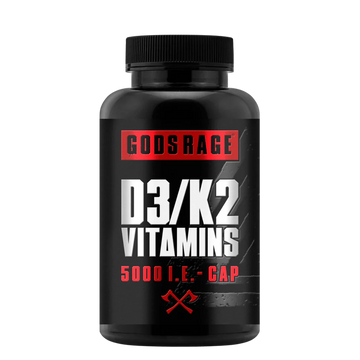
The Vitamin D3 K2 Liquid Caps from GN Laboratories contain 125 µg of vitamin D3, equivalent to 5,000 IU, and 200 µg of vitamin K2 per capsule as K2Vital® MK-7 all-trans. One tub contains 90 capsules. The recommended intake is one capsule every third day.
This high-dose product should only be used on medical advice and under medical supervision. According to the product information, it is not recommended for children or pregnant or breastfeeding women. The 5,000 IU are the content of one capsule, not a standard daily recommendation.
The two vitamins are combined in fixed amounts here. You cannot adjust their amounts within the capsule independently of each other. If your plan only provides for vitamin D, the additional K2 component therefore needs to be clarified separately. In our range of vitamin D3 and K2 supplements, you can compare the different forms and doses. The complete label remains decisive.
Frequently asked questions about vitamin D without K2
Do I automatically need K2 with 1,000 IU of vitamin D?
What if I forget my K2 once?
Sources
- NIH Office of Dietary Supplements: Vitamin K: Fact Sheet for Health Professionals. ods.od.nih.gov/factsheets/VitaminK-HealthProfessional/
- Deutsche Gesellschaft für Ernährung (DGE): Referenzwerte für Vitamin K. dge.de/wissenschaft/referenzwerte/vitamin-k/
- Bundesinstitut für Risikobewertung (BfR) (2025): Einnahme hoher Einzeldosen Vitamin D über Nahrungsergänzungsmittel im Abstand von Tagen oder Wochen birgt gesundheitliche Risiken (Stellungnahme 031/2025). bfr.bund.de/stellungnahme/einnahme-hoher-einzeldosen...
- Theiler-Schwetz V, Riedmann U, Zelzer S et al., Frontiers in Nutrition 13 (2026): Vitamin K status has no influence on the effect of vitamin D supplementation on bone turnover and cardiovascular markers: a randomized controlled trial. frontiersin.org/journals/nutrition/articles/10.3389/...
Further reading
-
 Image: AI-generated
Vitamin D in winter: sunlight, diet and supplements
What sunlight and food contribute in winter and how to read vitamin D values on the label.
Read article -
 Image: AI-generated
Vitamin D in the morning or evening: when should you take it?
Vitamin D in the morning or evening: choosing a suitable meal and reading amount and intake days correctly.
Read article

Leave a comment