How long does ashwagandha take to work? The timeline
Ashwagandha does not work at the push of a button, it works over weeks. This guide shows you the complete timeline: first effects, measurable results and what determines the pace.

Ashwagandha does not work at the push of a button, it works over weeks. Many people notice a calmer baseline mood after one to two weeks, and in clinical studies sleep, stress hormones and recovery improve measurably after six to twelve weeks of regular use. This guide lays out the complete timeline: what ashwagandha does in your body in the first hours, when the ashwagandha effect becomes noticeable, what determines the pace and how you can tell that your supplement is working. We wrote it for everyone who uses this medicinal plant with a purpose: athletes in hard training phases, stressed professionals and health-conscious people who want to improve sleep, stress resilience and wellbeing.
Key takeaways
- First subtle effects after 1 to 2 weeks: a calmer baseline mood, falling asleep more easily. Not yet for everyone and not yet stable.
- Measurable after 6 weeks: With the ashwagandha extract Shoden®, sleep quality rose by 72 % in a study with 150 people, compared with only 29 % under placebo1.
- Duration is the real lever: A meta-analysis of five controlled studies found the clearest benefits for sleep quality from 8 weeks onward and from a dose of 600 mg per day2.
- Stable after 8 to 12 weeks: sleep rhythm, recovery and inner resilience settle at a new level.
- Dose, withanolide content and consistency are what count. We stock both well-researched branded extracts: Ashwagandha Shoden® and Ashwagandha KSM-66®.

When does the ashwagandha effect kick in? The timeline at a glance
Ashwagandha needs weeks, not hours. The active compound itself leaves your body quickly, the benefit only emerges as your stress system adapts over a longer period. This timeline summarises what the research on how long ashwagandha takes to work says for each phase.
| Time window | What happens in this phase | Evidence |
| First hours | The plant's active compounds are absorbed and excreted again within 12 hours. No instant effect. | Human study with Shoden®7 |
| 1 to 2 weeks | First subtle changes: less inner restlessness, shorter time to fall asleep. Varies a lot from person to person. | Anecdotal, no hard evidence yet |
| 4 to 6 weeks | Sleep improves measurably: sleep quality, sleep onset and sleep efficiency get better. | Shoden® 120 mg, 6 weeks, 150 people1 |
| 8 weeks | The threshold in the research: from here the effect of ashwagandha becomes clear with regular use. | Meta-analysis of 5 studies2 |
| 60 days | Morning cortisol drops significantly, testosterone rises in men. | Shoden® 60 and 120 mg3, KSM-66® 600 mg4 |
| 8 to 12 weeks | Stable level for sleep, recovery and performance. | KSM-66® over 10 weeks5, safety review8 |
What is ashwagandha? The plant behind the extract
The ashwagandha plant (Withania somnifera) is a medicinal plant from Ayurvedic medicine, also known as winter cherry or Indian ginseng. It comes from India and neighbouring regions, where it has been used in Ayurveda for centuries. Botanically, Withania somnifera belongs to the nightshade family, and the root of this plant supplies the compounds that matter. Interest in the plant has risen sharply in the West in recent years, as more and more people look for plant-based options for periods of high strain. What Ayurvedic tradition has held for centuries is now being tested with controlled studies.
Ashwagandha belongs to the adaptogens: plants that are meant to help the body adapt to strain. Rhodiola and ginseng are adaptogens too, but ashwagandha is by far the best-studied plant in the group. For your health that means: of all adaptogens, this one has the most human studies behind it. The benefits are attributed to the withanolides, the active compounds of the root. It also matters which plant parts go into the extract: Shoden® is made from root and leaves, KSM-66® exclusively from the root. Both extracts come from specialised manufacturers, Shoden® from Arjuna Natural and KSM-66® from Ixoreal Biomed. This is exactly where the wheat separates from the chaff, because a ground powder of dried root contains only a fraction of the active compounds. In that form, Indian ginseng is much weaker than its reputation suggests.
The term adaptogen also explains why ashwagandha takes time. Adaptogens do not intervene in a single feedback loop the way a drug does, they slowly shift how your body responds to strain. In Ayurvedic medicine, ashwagandha has always been regarded as a means of supporting strength and calm, and modern research confirms exactly that picture: a quiet, slow effect rather than a fast stimulus. This long tradition in Ayurveda does not replace a study, but it explains why the ashwagandha plant has been studied so thoroughly and is taken seriously in Western medicine today. An adaptogen is therefore not a remedy for disease, but a support for a healthy body under pressure. That is exactly why intake is measured in weeks, not days.
Modern ashwagandha supplements therefore use standardised extracts in which the withanolide content is precisely declared. Only then can the dose be controlled at all, and only then is the effect of ashwagandha reproducible. In the end, what counts for your health is not how much plant material is in the capsule, but how much of it actually arrives. If you want to understand the plant from the ground up, the ultimate guide to ashwagandha has the long version.
How fast does ashwagandha work? The timeline of effects
The effect of ashwagandha builds gradually, not suddenly. Anyone expecting an instant effect from the plant stops taking ashwagandha in disappointment after ten days, and that is exactly where most attempts fail.
In the first hours something does happen biochemically, just nothing you can feel. A 2026 human study gave healthy adults 240 or 480 mg of Shoden® and detected the withanolides and their breakdown products in the urine within 12 hours7. So ashwagandha arrives, is processed and is gone again by the next day.
That is the heart of the matter: ashwagandha does not build up a blood level you can feel. The plant changes over weeks how your body responds to stress.
After 1 to 2 weeks many people report first subtle changes: less inner restlessness, a shorter time to fall asleep, a calmer baseline in everyday life. This ashwagandha effect is still weak and not the same for everyone, and hard study data for this early window is scarce.
After 4 to 6 weeks it becomes measurable. In a randomised study with 150 people with non-restorative sleep, participants took 120 mg of Shoden® daily for six weeks. Self-reported sleep quality rose by 72 %, in the placebo group only by 29 %. Sleep onset, total sleep time and sleep efficiency measured objectively by actigraphy also improved significantly1.
After about 8 weeks comes the threshold at which the data really becomes clear. A meta-analysis pooled five controlled studies with 400 participants and found a small but significant overall effect on sleep. It was more pronounced in exactly two subgroups: at a dose of 600 mg per day or more and with an intake duration of 8 weeks or longer2. Anyone who stops earlier or doses too low gives away exactly the part that matters.
After 60 days the hormonal benefits show most clearly. A study with Shoden® (60 mg and 120 mg daily) lowered the morning stress hormone cortisol by 66 and 67 % respectively, while it remained practically unchanged under placebo. Testosterone rose by 22 and 33 %, and participants' anxiety score fell by 59 %3. For the root extract KSM-66®, the Chandrasekhar study is the classic: a dose of 600 mg daily over 60 days lowered serum cortisol by around 27.9 %, compared with 7.9 % under placebo4.
After 8 to 12 weeks the result consolidates. Another study gave people with sleep problems 300 mg of this extract twice daily over 10 weeks and found clear improvements in sleep onset, sleep efficiency and night-time waking5. Concentration, performance and everyday energy also improve in this period, not before.
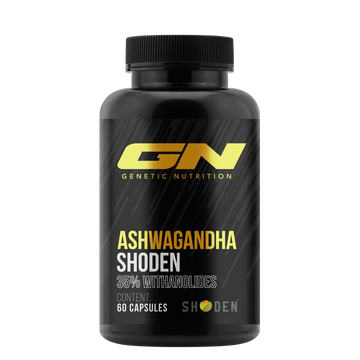
From our range: If you want the concentrated route, Ashwagandha Shoden® from GN Laboratories delivers 300 mg of Shoden® per capsule, including 105 mg of withanolides (35 %). That is the highest withanolide load in our range, obtained from two plant parts, root and leaf, made in Germany, lab-tested and vegan. One capsule a day is enough.
What determines the effect of ashwagandha?
The time until the effect sets in is individual, but it follows rules. These five factors decide whether ashwagandha works for you after six weeks or whether you are still waiting after twelve.
- The dose: 300 to 600 mg of standardised extract per day makes sense. The sleep meta-analysis saw the clearest benefits from 600 mg2. With highly concentrated extracts, however, what counts is not the milligram figure of the raw material but the withanolide content. More on this in the guide to the optimal ashwagandha dosage.
- The withanolide content: Two supplements with 300 mg of extract each can contain completely different amounts of active compounds. Shoden® is standardised to 35 % withanolide glycosides, KSM-66® to around 5 % free withanolides. A non-standardised powder is often far below that, and then you wait in vain for the ashwagandha effect.
- Consistency: Because the withanolides are excreted again within hours7, taking ashwagandha daily is not a chore, it is the precondition. If you reach for the capsule three times a week, you extend the time until a noticeable effect considerably or never get there at all.
- Your starting point: Body weight, metabolism, age and above all your baseline stress level play a role. People under heavy pressure have more room for improvement and often notice more, though sometimes later.
- Your lifestyle: Good sleep hygiene and moderate caffeine intake reinforce the perceived effect. Lots of screen time in the evening, shift work and strong stimulants can simply mask the calming component.
Taking ashwagandha: timing, form and duration
When taking ashwagandha, consistency decides, not the perfect moment. Still, there are a few levers that can save you weeks.
The form: Of all forms, ashwagandha capsules are the first choice, because the dose is exact and the bitter taste of the root is avoided. Ashwagandha powder is the cheaper but much weaker alternative, because ashwagandha powder can hardly be dosed precisely. Liquid supplements are rare and usually lower in concentration, which is why most extracts today are offered as capsules.
The timing: Taken in the morning, ashwagandha supports concentration and stress resilience during the working day. In the evening, about 30 to 60 minutes before bed, it fits the wind-down and combines well with taking magnesium in the evening. If you dose twice a day, split the daily dose between morning and evening, as the studies on the root extract did45.
With or without a meal: Ideally take the capsule with a meal containing fat, then it sits lightly in the stomach and the fat-soluble compounds are absorbed well. If you are generally sensitive to supplements, you can additionally support digestion with a digestive enzyme complex.
The duration: Plan a course of 8 to 12 weeks of regular use from the start. That is not an arbitrary figure, it is exactly the period in which the studies measured their effects25. Afterwards many people take a break of 2 to 4 weeks to reassess their own baseline without ashwagandha. That is exactly why the larger tub pays off: 120 capsules cover four months of continuous use without running out mid-course.
If you want to shape your evening even more deliberately, you will also find suitable sleep and relaxation formulas with us.

Effect of ashwagandha by goal: stress, sleep, sport and hormones
Each goal has its own timeline. The effects of ashwagandha on stress, sleep and performance set in at different times, so it is best to sort by your own area of application.
Stress and inner restlessness: Stress reduction is the area where the ashwagandha effect shows earliest. Many describe first changes in their baseline mood after 1 to 2 weeks, the hard numbers come from the studies after 60 days: the stress hormone clearly lowered, the anxiety score reduced by 59 %3. Ashwagandha regulates the stress axis, it does not sedate like a tranquilliser.
Sleep quality: Expect 4 to 6 weeks until a clear difference and 8 weeks until a stable result12. What improves most is sleep onset and sleep efficiency, meaning the share of time in bed that you actually spend asleep.
Performance and recovery: In sport, ashwagandha works indirectly, through better sleep and a lower stress hormone level. An improvement in muscle strength and recovery shows up in studies after 8 to 12 weeks and only ever in combination with structured training. Stress reduction works in your favour here: less cortisol means more muscle strength from the same training session. Ashwagandha does not replace a training stimulus, the adaptogen protects recovery between the stimuli.
Hormonal balance: In men, testosterone rose in the ashwagandha studies by 22 to 33 % from baseline after 60 days3. In another study with overweight men aged 40 to 70, DHEA-S also increased over 8 weeks6. These effects are moderate and stay within the natural range, they have nothing to do with pharmacological interventions.
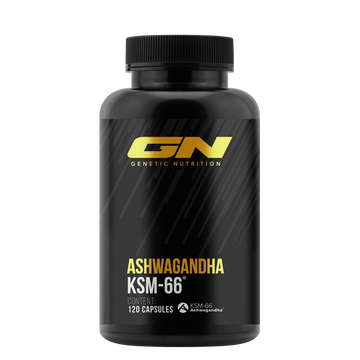
From our range: The meta-analysis saw the clearest sleep effects from a dose of 600 mg per day2, and that is exactly the amount Ashwagandha KSM-66® Highly Dosed from Gods Rage delivers in a single capsule, including 30 mg of withanolides. The study dose, without having to think about it twice a day. 120 capsules last four full months.
Short term or long term: what is realistic?
Realistic expectations decide whether an ashwagandha course delivers results or ends up in the cupboard after three weeks.
- First days: A slight calming or more tiredness is possible, especially with a higher dose in the evening. That is not a reliable effect yet.
- 4 to 6 weeks: Everyday stress feels more manageable, the rumination before falling asleep decreases, sleep gets deeper. First benefits in training become noticeable.
- 8 to 12 weeks: Sleep rhythm, recovery and performance stabilise, but only with regular use. Many people describe more energy in this phase, deeper relaxation in the evening and clearly better wellbeing.
And after stopping? The effect of ashwagandha lingers for a while and then fades gradually over days to a few weeks. A permanent change in the body that persists without intake is not proven. Ashwagandha is a course you can repeat, not a one-time switch.
Safety, risks and side effects of ashwagandha
Standardised ashwagandha extracts are well tolerated in studies. A 2026 systematic review specifically evaluated biomarkers and adverse events in healthy adults and found no serious side effects8. In the 90-day safety study on Shoden®, liver values, kidney function and blood lipids also remained without clinically relevant changes.
What can occur is mild and mostly a question of timing: slight stomach irritation, drowsiness or headaches, mostly when taken on an empty stomach. Take the capsule with a meal and the issue is usually settled.
For whom the risks outweigh the benefits: Ashwagandha is not suitable during pregnancy and breastfeeding, nor for children, because reliable data on the health of these groups is missing. For pregnancy there are simply no studies that would support a recommendation. With thyroid and autoimmune conditions and with known liver disease, use should be cleared with a doctor beforehand. Interactions are possible above all with blood pressure and blood sugar lowering medication, immunosuppressants, thyroid hormones and sedative drugs. Anyone taking medication permanently for chronic conditions is best advised to discuss intake with a doctor or pharmacist.
The regulators' view: In the EU, ashwagandha is classed as a food supplement, not an approved medicine. Because of the still thin data on long-term safety, the German Federal Institute for Risk Assessment advises a degree of restraint, since reliable data essentially covers periods of up to about twelve weeks. That is no cause for concern, it is exactly the reason why a course of 8 to 12 weeks followed by a break is the sensible approach. And it is the reason why a clearly declared, lab-tested branded extract beats any anonymous powder: you know what quality you are getting, and you know how much.

Ashwagandha in the daily life of athletes and stressed professionals
In everyday training, ashwagandha is a building block for recovery, not a performance supplement for the moment. The plant works where your progress actually happens: in the recovery between sessions.
If you increase your training volume, train late in the evening or work shifts, you lose sleep quality first, then recovery and finally performance. This is exactly the chain where ashwagandha as an adaptogen comes in. Ashwagandha combines without problems with the basics: creatine, protein powder, omega-3 and magnesium. And because ashwagandha calms in the evening while a pre-workout booster fires you up in the afternoon, the two do not get in each other's way as long as you keep them apart in time.
One tip that saves many courses: if you constantly run on high-dose caffeine, you mask the calming effect and then consider ashwagandha ineffective.
Goes well with it: For the evening we stock Sleep Like a BULL and Melatonin 1 mg. Both act in the short term, while ashwagandha does the weekly work in the background. If you want to secure your basic supply during training, add a multivitamin for athletes.
What should you look for when buying ashwagandha capsules?
The quality of the ashwagandha extract decides whether the timeline in this article applies to you at all. Three points separate an effective supplement from an expensive placebo.
- Standardisation instead of raw material quantity: The label must state how many milligrams of active compounds are inside, not just how much extract. Pure root extracts and combinations of several plant parts have better data than leaf blends and powders.
- Branded raw material with studies: Shoden® and KSM-66® are the two extracts on which the studies cited here are based. If you want the results of these studies, you should also take the raw material of these studies. Lab-tested quality and transparent declaration are not optional extras, they are the foundation.
- Pack size to match the course: A course runs 8 to 12 weeks. A tub that is empty after 30 days is not a course, it is a test.
This is how the three ashwagandha capsules you will find in our shop line up:
| Product | Extract per capsule | Withanolides | Capsules per day | Lasts for | Suits |
| Ashwagandha Shoden® (60 capsules) | 300 mg Shoden® | 105 mg (35 %) | 1 | 2 months | maximum concentration, stress and sleep |
| Ashwagandha KSM-66® (120 capsules) | 300 mg KSM-66® | 15 mg (5 %) | 1 to 2 | 2 to 4 months | the classic, broadly studied routine |
| Ashwagandha KSM-66® Highly Dosed (120 capsules) | 600 mg KSM-66® | 30 mg | 1 | 4 months | the 600 mg study dose in a single capsule |
With the root extract you have the choice: one capsule daily (300 mg) is the lean maintenance dose and lasts four months. Two capsules take you to the 600 mg at which the studies measured the clearest results24. If you would rather take that dose in one go, reach directly for the highly dosed version.
In short: For the most concentrated withanolide load, take Ashwagandha Shoden®. For the classic, most broadly studied routine, Ashwagandha KSM-66® with 300 mg. For the full study dose in one capsule, Ashwagandha KSM-66® Highly Dosed with 600 mg. All three supplements are lab-tested and clearly declared, you know with every capsule how many withanolides you are getting.
Conclusion: how long should you take ashwagandha?
Plan for 8 to 12 weeks, not less. First subtle effects are possible after 1 to 2 weeks, a clear difference in sleep shows after 4 to 6 weeks1, and the effect of ashwagandha becomes really clear from 8 weeks and from a dose of 600 mg per day2. If you give up after three weeks, you have not disproved the effect, you have only fallen short of the time.
The rest is craft: take it daily, with a meal, with an extract whose active compound content is stated on the label. After the course come 2 to 4 weeks without ashwagandha, in which you calmly assess what has changed for your wellbeing.
That is exactly why we stock the two extracts the research is built on: Shoden® with 105 mg of withanolides per capsule and KSM-66® with 600 mg per capsule. Pick the route that fits your goal, give it the weeks it needs, and then calmly judge what has changed for your wellbeing.
Frequently asked questions about how long ashwagandha takes to work
How long does ashwagandha stay in the body once I stop taking it?
Can I take ashwagandha permanently or do I need breaks?
Will I even notice ashwagandha if I use a lot of caffeine and pre-workout?
Does the timeline also apply to women?
What do I do if I notice nothing after several weeks?
Does powder work the same as capsules with extract?
Sources
- Deshpande A. et al., Sleep Medicine (2020): A randomized, double blind, placebo controlled study to evaluate the effects of ashwagandha (Withania somnifera) extract on sleep quality in healthy adults. pubmed.ncbi.nlm.nih.gov/32540634/
- Cheah K. L. et al., PLoS ONE (2021): Effect of Ashwagandha (Withania somnifera) extract on sleep: A systematic review and meta-analysis. pmc.ncbi.nlm.nih.gov/articles/PMC8462692/
- Heliyon (2024): Shoden promotes relief from stress and anxiety: A randomized, double-blind, placebo-controlled study on healthy subjects with high stress levels. pmc.ncbi.nlm.nih.gov/articles/PMC11402924/
- Chandrasekhar K. et al., Indian Journal of Psychological Medicine (2012): A prospective, randomized double-blind, placebo-controlled study of safety and efficacy of a high-concentration full-spectrum extract of ashwagandha root in reducing stress and anxiety in adults. pmc.ncbi.nlm.nih.gov/articles/PMC3573577/
- Langade D. et al., Cureus (2019): Efficacy and Safety of Ashwagandha (Withania somnifera) Root Extract in Insomnia and Anxiety: A Double-Blind, Randomized, Placebo-Controlled Study. pmc.ncbi.nlm.nih.gov/articles/PMC6827862/
- Lopresti A. L. et al., American Journal of Men's Health (2019): A Randomized, Double-Blind, Placebo-Controlled, Crossover Study Examining the Hormonal and Vitality Effects of Ashwagandha (Withania somnifera) in Aging, Overweight Males. pmc.ncbi.nlm.nih.gov/articles/PMC6438434/
- Speers A. B. et al., International Journal of Molecular Sciences (2026): Withanolides Are Detected in Human Urine Following Oral Administration of a Withania somnifera Product. pubmed.ncbi.nlm.nih.gov/42353009/
- Coope O. C. et al., Pharmaceuticals (2026): Back to the Roots: Safety and Tolerability of Standardised Ashwagandha (Withania somnifera) Root Extract in Healthy Adults. pmc.ncbi.nlm.nih.gov/articles/PMC13209861/