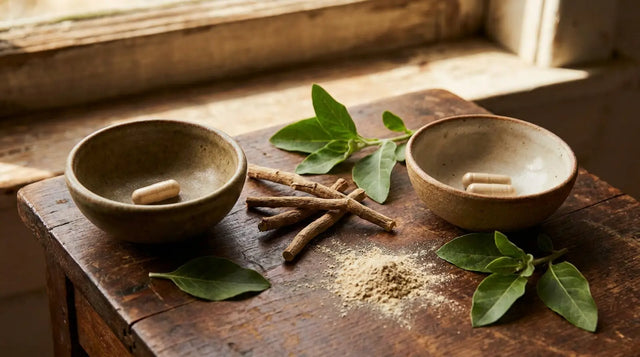
Ashwagandha Side Effects: Risks & Tolerability
How safe is ashwagandha really? What the research shows about side effects, risks and interactions, and how to take the winter cherry safely.

Ashwagandha is one of the best-researched herbal adaptogens, and standardised extracts are well tolerated in most clinical studies1. Still, a closer look is worth it, because side effects are exactly the topic that causes the most uncertainty. Which complaints can really occur when taking ashwagandha, who should be careful, and what does safe use look like? This guide sorts the evidence calmly, separates real risks from scaremongering and shows you what matters in a lab-tested product for your safety and health. Written for everyone who wants to use ashwagandha deliberately: for athletes in demanding phases, for stressed professionals and for health-conscious people who want to support sleep and stress resilience.
Key takeaways
- Well tolerated by healthy adults: standardised ashwagandha extracts showed no serious side effects in controlled studies1.
- The most common complaints are mild and usually a question of timing: slight stomach irritation or nausea, a drowsy feeling or headaches, especially on an empty stomach.
- Rare but worth taking seriously: possible effects on the thyroid, hormone balance and liver values. Here medical advice beats going it alone.
- Not suitable for pregnant or breastfeeding women and children; with pre-existing conditions or permanent medication, clarify use with your doctor first.
- Dosage, withanolide content and clear labelling are what count. In our range you will find three lab-tested, clearly declared extracts: Ashwagandha Shoden® and Ashwagandha KSM-66®.

How safe and well tolerated is ashwagandha?
For healthy adults, standardised ashwagandha at the usual dosage is considered well tolerated. A systematic review from 2026 specifically evaluated biomarkers and adverse events in healthy adults and found no serious side effects; liver values, kidney function and blood lipids showed no clinically relevant changes1.
The large studies on the root extracts confirm this picture. A trial with 600 mg of KSM-66® daily over 60 days lowered the stress hormone cortisol markedly and was well tolerated by the participants3, and a sleep study with the same extract likewise reported good tolerability4. For the highly concentrated Shoden® extract, a study with highly stressed adults showed the same calm safety profile5.
That does not mean ashwagandha suits everyone in every situation. There are real limits, and we will look at them closely in a moment. In the end, safety comes from the right balance of benefit and caution, not from fear; panic is a poor guide, factual information a good one.
Ashwagandha side effects at a glance: what can really occur
Most side effects of ashwagandha are mild, dose-dependent and temporary. Serious reactions are rare and mainly affect people with pre-existing conditions or very high doses. Roughly, the effects fall into three groups.
- Common and harmless: stomach and digestive irritation, tiredness, headaches. Usually in the first days and often a question of how you take it.
- Rare and worth taking seriously: possible effects on the thyroid, the hormone system and liver values. Relevant above all with a pre-existing condition.
- Situational: interactions with certain medications.
The good news first: if you are healthy, choose a standardised product and take the capsule with a meal, you will almost always stay in the first, harmless group. The benefit for health, wellbeing, sleep quality and inner balance then clearly outweighs the rest, and everything else can be managed with a few simple rules that follow below.
What is ashwagandha? Origins in Ayurvedic medicine
Ashwagandha (Withania somnifera) is a medicinal plant from Ayurvedic medicine, also known as winter cherry or Indian ginseng. Botanically the plant is a shrub from the nightshade family, and herbal medicine has described this medicinal plant for centuries. Its origins lie in India and in dry regions of Africa and the Mediterranean.
In Ayurvedic medicine the winter cherry is used to strengthen body and mind, to support recovery, and for exhaustion and sleep problems; against typical sleep problems it served as a herbal remedy long before modern drugs existed. It is mainly the root of Withania somnifera that is used, while some ashwagandha products and many simple winter cherry preparations also contain the leaves or other parts of the plant, and which parts end up in the extract determines the constituents and with them the tolerability profile. Clinical research judges poorly declared winter cherry preparations more cautiously than controlled trials on standardised branded extracts. A pure root extract has the best data, a ground powder from the whole plant far less. The winter cherry belongs to the adaptogens, plants that help the body adapt to strain, and research today points to ashwagandha helping the body do exactly that. As a medicinal plant and Indian ginseng the winter cherry has a long tradition, and ashwagandha is at the same time by far the best-studied adaptogen of this group. This broad body of research is also the reason why the benefits and side effects of this plant can be assessed so well.
Responsible for the effects are the withanolides, the active compounds of the root. Alongside them the plant contains further constituents whose amounts vary considerably by plant part, growing region and extraction: root and leaves do not deliver the same constituents. A standardised ashwagandha extract with a defined withanolide content is therefore far more predictable than an unstandardised powder. This is exactly where modern ashwagandha products part ways with basic ones: good products state the active content on the label, while in cheap products it fluctuates widely. As a medicinal plant and Indian ginseng the winter cherry traditionally strengthens resilience, and this long Ayurvedic tradition replaces no study; it only explains why the plant is researched so thoroughly today.
How the ashwagandha effect works, and why it can have side effects
The same ashwagandha effect many people want is also the reason for possible side effects: ashwagandha gently engages your stress system. The active compounds are the withanolides and their glycosides, plus further constituents. As an adaptogen the plant slowly changes how your body responds to stress instead of blocking a single pathway like a drug. This broad effect on body and stress system explains why a good adaptogen helps with stress on the one hand and can trigger mild effects in sensitive people on the other.
On the nervous system the plant works calmingly, which is welcome in the evening and can show up as drowsiness during the day. Hormonally, ashwagandha can lower the stress hormone cortisol: in a study with 600 mg of KSM-66® daily over 60 days, serum cortisol fell by around 27.9%, versus 7.9% under placebo3. At the same time the plant can influence several hormones, from thyroid values to sex hormones, and a lower level of the stress hormone shifts other hormones slightly with it. For healthy people these effects are usually unproblematic, but they are where the cautions for certain conditions below come from.
An important point for perspective: the active compound itself leaves the body quickly. In a human study with Shoden®, the withanolides and their breakdown products were detectable in urine within twelve hours2. Ashwagandha therefore builds no blood level you can feel; the benefit comes from your stress system adapting over weeks. That also explains why daily, regular intake matters so much.

Common, mild side effects and how to avoid them
The most common unwanted effects are mild, and almost all of them can be avoided by choosing the right moment to take the capsule. Most users report good tolerability at moderate doses, but a few typical complaints can occur in the first days.
| Possible side effect | Frequency | What simply helps |
| Stomach irritation, nausea | Occasional | Take the capsule with a meal |
| Tiredness, drowsiness | Occasional | Take it in the evening instead of the morning |
| Headaches | Rare | Drink enough, start low |
| Dizziness, light-headedness | Rare | Check the dose, combine with a meal |
| Skin reactions | Very rare | Stop taking it if they occur |
Almost all of these complaints are dose-dependent, and the simple fixes lie in the intake itself.
The stomach: take the capsule with a slightly fatty meal; it sits lightly in the stomach and the fat-soluble compounds are absorbed well.
The tiredness: the calming note is part of the effect. If you want to stay wide awake during the day, take the capsule in the evening and let it work overnight.
Vivid dreams: some people dream more intensely in the first weeks, a sign of deep relaxation. If you prefer it quieter, take the capsule a little earlier in the evening. With clear or persistent complaints the honest path applies: stop and get medical advice instead of pushing through.
Rare, serious risks: liver, thyroid and hormone balance
Serious reactions are rare, but they belong to honest information. Affected above all are the liver, the thyroid and the hormone balance, which matters for people with pre-existing conditions.
Liver
In controlled studies with standardised extracts, liver values showed no clinically relevant changes1. Individual case reports, however, describe elevated liver values in connection with ashwagandha products. A clear causal link has so far not been established in controlled trials with standardised extracts, and with known liver disease caution applies anyway when combining several products. Germany's Federal Institute for Risk Assessment (BfR) advises a degree of restraint because long-term data are still thin. Exactly this is a strong argument for a clearly declared, lab-tested branded extract and cycled use: you know precisely what is inside and in what amount.
Thyroid
Ashwagandha can influence thyroid values, as it can slightly raise thyroid hormones. For healthy people this is usually unproblematic. With a thyroid condition such as Hashimoto's or an existing overactive thyroid, use belongs in a doctor's hands first.
Hormone balance
Ashwagandha can shift the hormone balance gently, and for most people that is precisely the desired effect. In the Shoden® study with highly stressed adults, the stress hormone fell by 66 to 67% and the anxiety score by 59%, while the men's testosterone rose by 22 to 33%, all within the natural range5. In women the effect on testosterone was not studied, but the effect on stress and sleep applies to both sexes. That sounds attractive for athletes, but with hormone-dependent conditions it is a reason for medical advice. Anyone with known conditions of the thyroid, hormone system or liver function, and anyone with known liver disease, is better off not using it on their own, as ashwagandha can additionally shift hormones and the level of the stress hormone.
Ashwagandha and medication: possible interactions
Natural does not automatically mean free of side effects, and that also applies to combining it with medication. If you are on regular medication, discuss ashwagandha with your doctor or pharmacist first, because interaction with medication is the most important reason for caution here; note the following points. Interactions with medication are possible above all with these groups:
- Sedatives and sleep medication (benzodiazepines, sedating antidepressants): the calming effects can add up and increase drowsiness.
- Thyroid medication (such as levothyroxine): ashwagandha can shift thyroid values.
- Antidiabetics: since the plant can influence blood sugar, caution applies with insulin or oral antidiabetics.
- Blood pressure medication: an additive effect is theoretically possible, so take care with low blood pressure.
- Immunosuppressants: ashwagandha could stimulate the immune system and interfere with intended immunosuppression.
Always mention ashwagandha in your medical history, as it can also influence lab values. If you take medication permanently, clarify use with your doctor first and then start calmly.
Who should not take ashwagandha?
Some groups should avoid ashwagandha because solid data are missing or the risk outweighs the benefit. These limits are clearly defined.
- Pregnant women: not suitable in pregnancy; there are no robust studies to support a recommendation.
- Breastfeeding women: the data on transfer into breast milk are unclear, so breastfeeding women better avoid the plant. Women in the menopause often use ashwagandha for support as well, but with hormonal changes in the menopause they should clarify use with a doctor first.
- Children and teenagers: hardly any studies, so no use without medical supervision.
- Liver or thyroid conditions: only after medical clearance.
- Autoimmune conditions: discuss beforehand because of the possible effect on the immune system.
This is not a long list of bans, but the honest flip side of an effective herbal extract. For healthy adults, ashwagandha remains a very well-studied adaptogen and a safe option for stress and sleep.
Taking ashwagandha safely: dosage, form and quality
For safe use of ashwagandha three things decide: the right dosage, the right form and the quality of the extract.
The dosage: sensible is 300 to 600 mg of standardised extract per day, the range of most clinical studies34. A meta-analysis on sleep saw the clearest effects from 600 mg and from 8 weeks of intake6. With highly concentrated extracts what counts is not the milligram figure of the raw material but the withanolide content. Which dosage fits which goal is covered in detail in our guide to the optimal ashwagandha dosage.
The form: as a food supplement, ashwagandha comes in several forms, and not all ashwagandha products are equal. Ashwagandha capsules with standardised extract are the first choice, because the dose is exact and the bitter taste of the root disappears. Ashwagandha powder can be dosed more flexibly but is often less standardised, and powder also varies more from batch to batch. Teas and traditional Ayurvedic preparations are hard to dose and depend heavily on the maker. As a food supplement, such products always remain an addition, not a substitute for good sleep, nutrition and training.
The intake: start slowly if your stomach is sensitive, take the capsule with a slightly fatty meal and do not combine it with alcohol or strongly sedating products. That way the mild effects usually stay away altogether.
The duration: plan a cycle of 8 to 12 weeks, then a break of 2 to 4 weeks. This matches the period for which solid study data exist and is the cautious path for an extract whose long-term data are still thin.
From our range: if you want the concentrated route, Ashwagandha Shoden® by GN Laboratories delivers 300 mg of extract per capsule, of which 105 mg withanolides (35%). That is the highest withanolide concentration in our range, made in Germany, lab-tested and vegan. One capsule a day is enough, and the label states exactly what is inside.
What to look for when buying ashwagandha capsules
When buying ashwagandha capsules, three criteria separate reliable products from weak ones: standardisation, branded raw material and a pack size that fits the cycle. Because not all ashwagandha products deliver what they promise.
- Standardisation over raw material amount: the label must state how many milligrams of withanolides are inside, not just how much extract. Pure root extracts have the best data.
- Branded raw material with studies: Shoden® by Arjuna Natural and KSM-66® by Ixoreal Biomed are the extracts behind the studies cited here. If you want the results of those studies, take the raw material of those studies.
- Pack size for the cycle: a cycle runs 8 to 12 weeks. A tub that is empty after 30 days will not get you there.
This is how the three ashwagandha capsules in our range line up:
| Product | Extract per capsule | Withanolides | Capsules per day | Labelling | Fits |
| Ashwagandha Shoden® (GN Laboratories, 60 capsules) | 300 mg Shoden® | 105 mg (35%) | 1 | clearly declared, lab-tested, vegan | maximum withanolide load, stress and sleep |
| Ashwagandha KSM-66® (GN Laboratories, 120 capsules) | 300 mg KSM-66® | 15 mg (5%) | 1 to 2 | clearly declared, lab-tested | the mild everyday root extract |
| Ashwagandha KSM-66® highly dosed (Gods Rage, 120 capsules) | 600 mg KSM-66® | 30 mg | 1 | clearly declared | the study dose of 600 mg in one capsule |
The good tolerability has a concrete reason here: with each of these three extracts, the label tells you how much active substance you get. Exactly this transparency is what the BfR recommends as the cautious path, and exactly this separates a branded extract from anonymous powder.
From our range: for the broadly studied everyday routine take the Ashwagandha KSM-66® with 300 mg by GN Laboratories, the mild root extract. If you want the full study dose of 600 mg in one capsule, go for the Ashwagandha KSM-66® highly dosed by Gods Rage with 600 mg. Both are clearly declared; with every capsule you know how many withanolides you get.
Putting ashwagandha in its place in your training routine
In training, ashwagandha is a building block for recovery, not a compound for the moment. The plant works where your progress is made: in the recovery between sessions, through better sleep and a lower stress hormone level. The benefit is real but individual: some report more wellbeing, better sleep quality and steadier performance, others respond less. As an adaptogen, ashwagandha mainly supports sleep and stress resilience, which indirectly benefits recovery, muscle building and performance. Such products replace no training; they support the recovery in between and give it more stability over weeks.
Ashwagandha combines without problems with the basics like creatine, protein powder, omega-3 and magnesium, as long as you separate it in time from stimulants. Anyone permanently running high-dose caffeine or a pre-workout booster masks the calming effect and then wrongly writes the winter cherry off as ineffective. Exactly in this recovery chain ashwagandha works as an adaptogen, buffering stress and stabilising sleep over weeks. These realistic notes protect against disappointment and against needlessly high doses, and they show that the winter cherry serves above all to support recovery, not as a quick fix.
Pairs well with it: as milder building blocks for sleep and relaxation we carry melatonin 1 mg and magnesium citrate, plus further sleep and relaxation formulas. Both act short-term, while ashwagandha does the week-by-week work in the background.
Conclusion: when ashwagandha makes sense, and when not
For healthy adults, ashwagandha is a well-studied, mostly well-tolerated option for stress, sleep quality and recovery1. As an adaptogen this medicinal plant unfolds its benefit slowly over weeks and supports wellbeing best when you take it regularly. The mild side effects are usually a question of timing, and the serious risks concern clearly defined groups.
Everything points to ashwagandha being a safe choice for most healthy adults. Even the Federal Institute for Risk Assessment advises only a degree of restraint for long-term use, because data beyond twelve weeks are still thin, and exactly that supports cycled use. The safe path is simple: a standardised, lab-tested branded extract, a dose within the study range and a cycle of 8 to 12 weeks followed by a break. If you have a pre-existing condition or take medication permanently, clarify use with your doctor first. Everyone else can start calmly and well informed.
From our range: exactly for this we carry three clearly declared extracts: Ashwagandha Shoden® by GN Laboratories with 105 mg withanolides per capsule, the Ashwagandha KSM-66® with 300 mg as the mild everyday root extract and the Ashwagandha KSM-66® highly dosed by Gods Rage with 600 mg for demanding phases. With every capsule you know exactly how many withanolides you get.
Frequently asked questions about ashwagandha side effects
How quickly do side effects appear after taking ashwagandha?
Can I take ashwagandha daily and long term?
Does ashwagandha make you tired?
Does ashwagandha affect the thyroid?
Can I combine ashwagandha with caffeine or pre-workout boosters?
Is ashwagandha safe for women?
Are there milder alternatives to ashwagandha?
Sources
- Coope O. C. et al., Pharmaceuticals (2026): Back to the Roots: Safety and Tolerability of Standardised Ashwagandha (Withania somnifera) Root Extract in Healthy Adults. pmc.ncbi.nlm.nih.gov/articles/PMC13209861/
- Speers A. B. et al., International Journal of Molecular Sciences (2026): Withanolides Are Detected in Human Urine Following Oral Administration of a Withania somnifera Product. pubmed.ncbi.nlm.nih.gov/42353009/
- Chandrasekhar K. et al., Indian Journal of Psychological Medicine (2012): A prospective, randomized double-blind, placebo-controlled study of safety and efficacy of a high-concentration full-spectrum extract of ashwagandha root in reducing stress and anxiety in adults. pmc.ncbi.nlm.nih.gov/articles/PMC3573577/
- Langade D. et al., Cureus (2019): Efficacy and Safety of Ashwagandha (Withania somnifera) Root Extract in Insomnia and Anxiety: A Double-Blind, Randomized, Placebo-Controlled Study. pmc.ncbi.nlm.nih.gov/articles/PMC6827862/
- Heliyon (2024): Shoden promotes relief from stress and anxiety: A randomized, double-blind, placebo-controlled study on healthy subjects with high stress levels. pmc.ncbi.nlm.nih.gov/articles/PMC11402924/
- Cheah K. L. et al., PLoS ONE (2021): Effect of Ashwagandha (Withania somnifera) extract on sleep: A systematic review and meta-analysis. pmc.ncbi.nlm.nih.gov/articles/PMC8462692/