Ashwagandha dosage: how much you take, when and in which form
The right dosage for most goals sits between 300 and 600 mg of standardised extract per day. This guide shows which amount fits which goal, when to take it and how long a course runs.

The right ashwagandha dosage for most goals sits between 300 and 600 mg of standardised extract per day, and it depends less on the milligram number on the pack than on the withanolide content and on your goal. This is exactly where many people fail: they grab any product, take an arbitrary amount and wonder why nothing happens after two weeks. This guide lays out the concrete numbers: which dose the studies use for stress, sleep and sport, whether you take ashwagandha in the morning or in the evening, how long a course runs and which product fits which dose. We wrote it for everyone who wants to use this medicinal plant deliberately: for athletes in hard training phases, for stressed professionals and for health-conscious people who want to improve sleep and stress resilience.
The essentials in brief
- Standard dose 300 to 600 mg per day: for stress the lower range is often enough, for sleep and sport the studies show the clearest effects from 600 mg
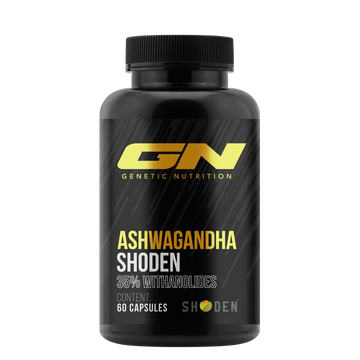
- It is not the mg that count, but the withanolides: 300 mg of Shoden® deliver 105 mg of withanolides (35%), 300 mg of KSM-66® around 15 mg (5%)
- Timing by goal: mornings for focus and stress resilience, evenings for sleep; what decides is daily consistency
- Meant as a course: 8 to 12 weeks straight, then 2 to 4 weeks off

Ashwagandha dosage at a glance: how much for which goal
For healthy adults, a sensible daily dose is 300 to 600 mg of standardised ashwagandha extract. Which amount is right for you is decided by your goal, not your body weight. This table matches the doses used in studies to the applications and shows which product covers each dose most cleanly.
| Goal | Daily dose in studies | Matching product | Capsules per day |
| Stress and inner calm | 300 to 600 mg | Shoden® (105 mg withanolides) or KSM-66® with 300 mg | 1 |
| Sleep quality | from 600 mg, rather in the evening | KSM-66® highly dosed 600 mg or 2 x KSM-66® 300 mg | 1 or 2 |
| Sport, strength and hormonal balance | 600 mg | KSM-66® highly dosed 600 mg | 1 |
| Highest withanolide concentration | 300 mg extract = 105 mg withanolides | Shoden® | 1 |
| Everyday life, start and maintenance | 300 mg extract | KSM-66® with 300 mg | 1 |
These values are orientation values from controlled studies, not a rigid rule. Above all, one thing applies to this ashwagandha dosage: start with the lower range, stay with it for at least four to six weeks and only increase once you know how well you tolerate it.
Ashwagandha extract, powder or capsules: what the dose refers to
Ashwagandha, botanically Withania somnifera and also called sleepberry or Indian ginseng, is an adaptogen: a plant that helps the body adapt to strain. The sleepberry has centuries of tradition in Ayurvedic medicine, and what Ayurveda has passed down is now being tested by research in controlled studies. Before you reach for an amount, though, you need to know what a dose even refers to, because extract and powder are not the same. The ashwagandha extract is concentrated and standardised to a fixed share of withanolides, the active compounds of the plant. Root powder, on the other hand, is just the ground root, cheaper but clearly weaker, which is why 3 to 6 g per day are traditionally needed here instead of a few hundred milligrams of extract.
The decisive value therefore sits not with the extract milligrams but with the withanolide content. Two capsules with 300 mg of extract each can deliver completely different amounts of active compound: Shoden® is standardised to 35% withanolide glycosides and thus brings 105 mg of withanolides per capsule, the broadly studied KSM-66® to around 5%, so about 15 mg. The more concentrated the extract, the more active compound sits in less capsule. Exactly this is why the look at the label pays off: the withanolide content per daily serving should be stated openly there, and your dose follows from it.
Ashwagandha capsules are the most practical form for most people, because the dose is exact, the bitter root taste is gone and there is nothing to weigh. Powder offers more flexibility and can be stirred into shakes, but tastes earthy and is hard to dose precisely. If you take dosing seriously, you are better served with a standardised extract in capsule form.

How much ashwagandha per day? The study doses from 250 to 600 mg
Most studies work with 250 to 600 mg of standardised extract per day, often split into two servings. In the classic study by Chandrasekhar, participants took 300 mg of KSM-66® twice daily over 60 days: their morning serum cortisol fell by 27.9%, under placebo only by 7.9%1. A meta-analysis of five controlled studies with around 400 participants found the clearest benefits for sleep from a dosage of 600 mg daily and from eight weeks of intake2.
The look at highly concentrated extracts is exciting. In a study with 150 people, as little as 120 mg of Shoden® daily was enough to improve self-reported sleep quality by 72% over six weeks, versus 29% under placebo5. The reason is the high withanolide share: where a lot of active compound sits in little extract, a smaller amount is enough for the same result.
For getting started: take 300 mg of standardised extract per day, observe yourself over 7 to 14 days and increase towards 600 mg if needed. Higher amounts up to about 1,250 mg occasionally appear in studies, but a reliable additional benefit beyond that is not proven, while the well-studied effects sit in the range of 300 to 600 mg. More milligrams are no end in themselves here.
Dosage by goal: how you steer the effect of ashwagandha
The optimal dose shifts depending on the application, because the effect of ashwagandha sets in at different times and amounts for stress, sleep and sport. So sort by your own area of application.
Stress and inner calm: Here the lower range of 300 to 600 mg of standardised extract is often enough. In a study with Shoden®, the stress hormone cortisol fell by 66 and 67% respectively against practically unchanged placebo, and the participants' anxiety score dropped by 59%3. Ashwagandha regulates the stress axis in the process; it does not sedate like a tranquilliser.
Sleep quality: For better sleep, the studies show the clearest results from 600 mg per day2, taken rather in the evening. Split doses work too: in one study, people with sleep problems took 300 mg of KSM-66® twice daily over ten weeks, with clear improvements in sleep onset time and sleep efficiency4.
Sport, strength and hormonal balance: In sport, 600 mg per day is usually used, over 8 to 12 weeks and also on rest days. In men, testosterone levels rose by 22 to 33% against baseline after 60 days in the studies3, and in overweight men between 40 and 70, DHEA-S additionally increased over eight weeks7. Ashwagandha replaces no training stimulus; it protects the recovery between the stimuli, and less cortisol means more strength from the same session.
General well-being and immune system: As a moderate start, 300 mg daily over 6 to 12 weeks is enough. As an adaptogen, ashwagandha works here towards the body's balance and supports performance and well-being over time, not like a fast stimulant.
The doses and time windows apply equally to women and men, by the way. Only the effects on testosterone levels were measured in men, not in women.
From our range: The studies on strength and hormonal balance work with 600 mg, and exactly this amount is delivered by Ashwagandha KSM-66® Highly Dosed by Gods Rage with 600 mg in one single capsule, including 30 mg of withanolides. The full study dose, without having to think about it twice a day. 120 capsules last four months.

More is not better: what high doses do to the ashwagandha effect
A higher dose does not automatically bring more effect. The ashwagandha effect does not follow a straight line: above 600 mg per day, the proven benefit hardly grows further, while mild side effects become more likely. The range of 300 to 600 mg is therefore no compromise, but the range with the best ratio of benefit and tolerability.
Ashwagandha is a food supplement, not a medicine, and standardised extracts are considered well tolerated. What can occur is mild and mostly a question of timing: light stomach irritation or tiredness, especially on an empty stomach or with a high evening dose. Take the capsule with a meal, then it sits lightly in the stomach.
Ashwagandha is not suitable for pregnant or breastfeeding women and for children, because solid data for pregnancy and breastfeeding is missing. Anyone with thyroid, liver or autoimmune conditions or on permanent medication clarifies the intake with a doctor beforehand. That is no reason to worry, but the reason why a clearly declared, lab-tested branded extract beats any anonymous powder: you know exactly how much active compound you are taking. Everything on tolerability, interactions and who should be particularly careful is covered in our guide on ashwagandha side effects.
Take ashwagandha in the morning or in the evening?
There is no universally best time: whether you take ashwagandha in the morning or in the evening depends on your goal. What decides the effect anyway is daily consistency, not the time of day.
Morning fits if you are after stress resilience, composure and focus across the day. The body's stress hormone cortisol is highest in the morning, and the studies that measured a lower cortisol level determined it in the morning13. An intake early in the day accompanies this rhythm.
Evening makes sense if sleep is your main goal, about 30 to 60 minutes before going to bed. The sleep studies gave their dose matched to the evening or spread across the day45.
Split is the third option: 300 mg in the morning and 300 mg in the evening make the 600 mg with which the meta-analysis found the clearest results2. That way you get both, daytime composure and evening calm. Morning or evening, if you react sensitively on an empty stomach, tie the intake to a meal.
Taking ashwagandha: meal, duration and course
With ashwagandha intake, continuity decides the result, not the perfect single moment. A few levers still help to save weeks.
With a meal: Take the capsule ideally with a meal containing fat, then the fat-soluble withanolides are absorbed well and the capsule sits lightly in the stomach.
As a course over weeks: Ashwagandha is no acute pill. The clinical studies ran over 6 to 12 weeks with daily intake124. Why daily? Because the withanolides are excreted again quickly: a human study from 2026 gave healthy adults 240 or 480 mg of Shoden® and found the active compounds in the urine within twelve hours6. A level you can feel does not build up on its own; daily ashwagandha intake is therefore the condition, not busywork.
With a break: Plan 8 to 12 weeks straight from the start, then 2 to 4 weeks off, to reassess your own baseline without ashwagandha. Exactly this is why the bigger tub pays off: 120 capsules cover four full months at one capsule per day, without your supply running out mid-course.
KSM-66 and Shoden compared: which dose in which extract
The two best-studied branded extracts are called KSM-66® and Shoden®, and they differ exactly where it counts for dosing: in withanolide content and in the plant part used. KSM-66® is obtained exclusively from the root and is standardised to around 5% withanolides, the broadly studied everyday root extract on which most of the studies cited here are based. Shoden® comes from root and leaves and is standardised to 35% withanolide glycosides, the highest concentration on the market. For a detailed comparison of both extracts, from concentration and research to choosing by goal, read our article Ashwagandha Shoden vs. KSM-66.
This is how the three ashwagandha products you find in our shop line up:
| Product | Extract per capsule | Withanolides | Capsules per day | Lasts for | Fits |
| Ashwagandha Shoden® (60 capsules) | 300 mg Shoden® | 105 mg (35%) | 1 | 2 months | maximum withanolide concentration, stress and sleep |
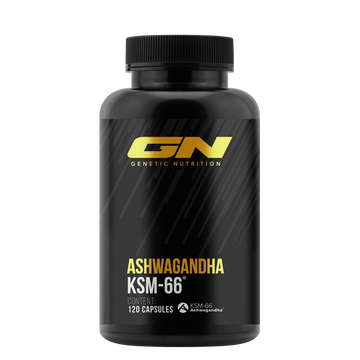
| Ashwagandha KSM-66® (120 capsules) | 300 mg KSM-66® | 15 mg (5%) | 1 to 2 | 2 to 4 months | the classic, broadly studied routine |
| Ashwagandha KSM-66® Highly Dosed (120 capsules) | 600 mg KSM-66® | 30 mg | 1 | 4 months | the study dose of 600 mg in one capsule |
With the root extract you have the choice: one capsule daily (300 mg) is the lean maintenance dose for everyday life and stress and lasts four months. Two capsules bring you to the 600 mg at which the studies measured the clearest results for sleep and sport24. If you prefer to take this dosage in one go, reach for the highly dosed version with 600 mg in one capsule. And if you want the most concentrated load of withanolides, take Shoden®: 105 mg of withanolides from one single capsule per day.
In short: For the most concentrated load of withanolides, take Ashwagandha Shoden® by GN Laboratories with 105 mg of withanolides per capsule. For the classic, most broadly studied routine, Ashwagandha KSM-66® with 300 mg. And for the full study dose in one capsule, Ashwagandha KSM-66® Highly Dosed by Gods Rage with 600 mg. All three are lab-tested and clearly declared; with every capsule you know how many withanolides you get.
What to look for when buying ashwagandha capsules
The best dosage is useless if the quality is not right, and especially online the withanolide amounts of many products vary enormously. Three points separate an effective product from an expensive placeholder.
- Withanolides instead of raw material amount: The label must state how many milligrams of withanolides sit in a daily serving, not just how much extract. Without this figure, the dose cannot be steered.
- Branded raw material with studies: KSM-66® and Shoden® are the extracts on which the cited studies are based. If you want their results, take their raw material, lab-tested and transparently declared.
- Pack size to match the course: A course runs 8 to 12 weeks. A tub that is empty after 30 days is a test, not a course.
With us you find both study raw materials as own-brand products: the concentrated Shoden® and the KSM-66® by GN Laboratories, plus the highly dosed 600 mg version by Gods Rage, all with openly declared withanolide content.
Conclusion: your ashwagandha dosage in three steps
The right ashwagandha dosage is no secret, but a question of three decisions. First the amount: 300 mg of standardised extract for stress and getting started, 600 mg for sleep and sport, where the clearest study effects sit2. Second the timing: morning for the day, evening for sleep, daily and ideally with a meal. Third the duration: 8 to 12 weeks as a course, then a break.
The rest is craft: an extract whose withanolide content is stated on the label, and the patience to give it the weeks it needs. Whoever gives up after three weeks has not disproven the effect, only undercut the time.
From our range: For the concentrated route, Ashwagandha Shoden® by GN Laboratories delivers 105 mg of withanolides per capsule, for the classic routine KSM-66® by GN Laboratories with 300 mg, and for the full study dose Ashwagandha KSM-66® Highly Dosed by Gods Rage with 600 mg. Pick the dose that fits your goal and give it the weeks it needs.
Goes well with: If sleep is your goal, fast helpers step in during the evening while ashwagandha does the weekly groundwork in the background. For that we carry Melatonin 1 mg and Sleep Like a BULL as well as further sleep and relaxation formulas.
Frequently asked questions about ashwagandha
How much ashwagandha should I take per day?
Do I take ashwagandha in the morning or in the evening?
How fast does ashwagandha work at the right dosage?
Can I simply double the dose if I feel nothing?
Is powder just as good as capsules with extract?
Should I take ashwagandha permanently or take breaks?
Sources
- Chandrasekhar K. et al., Indian Journal of Psychological Medicine (2012): A prospective, randomized double-blind, placebo-controlled study of safety and efficacy of a high-concentration full-spectrum extract of ashwagandha root in reducing stress and anxiety in adults. pmc.ncbi.nlm.nih.gov/articles/PMC3573577/
- Cheah K. L. et al., PLoS ONE (2021): Effect of Ashwagandha (Withania somnifera) extract on sleep: A systematic review and meta-analysis. pmc.ncbi.nlm.nih.gov/articles/PMC8462692/
- Heliyon (2024): Shoden promotes relief from stress and anxiety: A randomized, double-blind, placebo-controlled study on healthy subjects with high stress levels. pmc.ncbi.nlm.nih.gov/articles/PMC11402924/
- Langade D. et al., Cureus (2019): Efficacy and Safety of Ashwagandha (Withania somnifera) Root Extract in Insomnia and Anxiety: A Double-Blind, Randomized, Placebo-Controlled Study. pmc.ncbi.nlm.nih.gov/articles/PMC6827862/
- Deshpande A. et al., Sleep Medicine (2020): A randomized, double blind, placebo controlled study to evaluate the effects of ashwagandha (Withania somnifera) extract on sleep quality in healthy adults. pubmed.ncbi.nlm.nih.gov/32540634/
- Speers A. B. et al., International Journal of Molecular Sciences (2026): Withanolides Are Detected in Human Urine Following Oral Administration of a Withania somnifera Product. pubmed.ncbi.nlm.nih.gov/42353009/
- Lopresti A. L. et al., American Journal of Men's Health (2019): A Randomized, Double-Blind, Placebo-Controlled, Crossover Study Examining the Hormonal and Vitality Effects of Ashwagandha (Withania somnifera) in Aging, Overweight Males. pmc.ncbi.nlm.nih.gov/articles/PMC6438434/