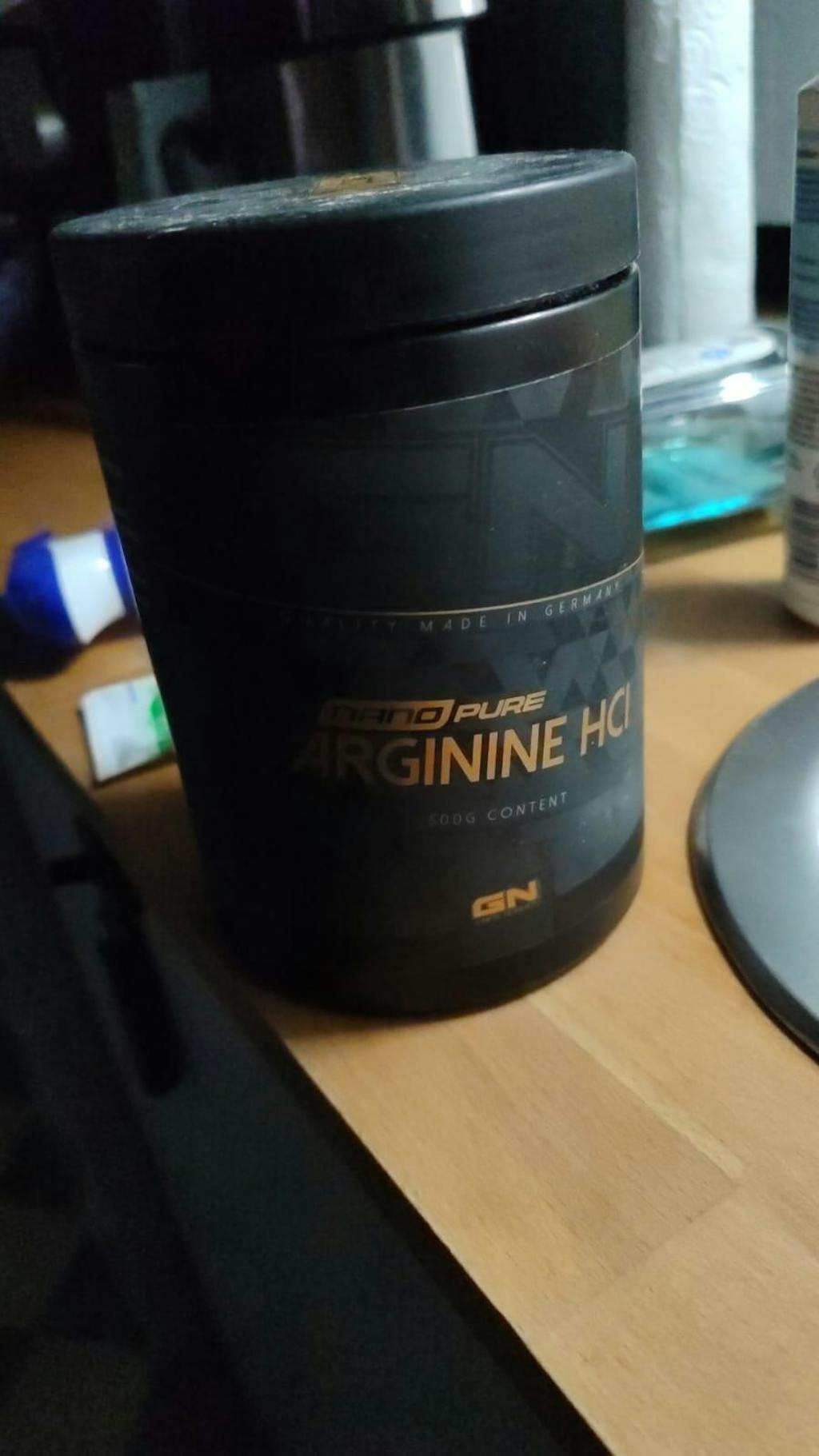
Was steckt in diesem L-Arginin Pulver?
L-Arginin-Hydrochlorid ist die Salzform der semi-essentiellen Aminosäure L-Arginin und ein wichtiger Baustein von Proteinen. Der Körper nutzt sie als Ausgangsstoff für die Bildung von Stickstoffmonoxid (NO)¹⁾, ein Signalmolekül, das am Kreislaufsystem und an der Nährstoffverteilung während körperlicher Belastung beteiligt ist²⁾. Genau deshalb ist die Aminosäure seit Jahren fester Bestandteil vieler Pre-Workout-Stacks.
Warum die HCL-Form? Die reine Base-Form ist stark basisch (pH ~11), schmeckt bitter und löst sich in Wasser nur mäßig auf. Das Hydrochlorid neutralisiert den pH-Wert, schmeckt nahezu neutral und geht rückstandsfrei in Lösung. Wer sein Pulver täglich in einen Shake rührt, merkt den Unterschied beim ersten Schluck.
HCL oder L-Arginin Base Pulver – wo liegt der Unterschied?
L-Arginin gibt es als HCL, Base und AAKG. Alle drei liefern dieselbe Aminosäure, unterscheiden sich aber deutlich in der Praxis:
| Eigenschaft | HCL | Base | AAKG |
| Reingehalt | ~83 % | ~98-100 % | ~67 % |
| Löslichkeit | Sehr gut | Mäßig | Gut |
| Geschmack | Nahezu neutral | Bitter | Leicht säuerlich |
| pH-Wert | Neutral | Basisch (pH ~11) | Neutral |
| Bioverfügbarkeit | Hoch | Mittel | Mittel |
| Magenverträglichkeit | Sehr gut | Kann reizen | Gut |
Auf dem Papier sieht L-Arginin Base Pulver mit ~98 % Reingehalt am besten aus. In der Praxis schmeckt es bitter, löst sich schlecht auf und kann bei empfindlichem Magen Probleme machen. AAKG (Arginin-Alpha-Ketoglutarat) kombiniert die Aminosäure mit Alpha-Ketoglutarsäure, liefert dafür aber nur ~67 % reines L-Arginin pro Portion.
Wer täglich Arginin Pulver vor dem Training nimmt, will kein bitteres Pulver mit Bodensatz im Glas. Das HCL geht rückstandsfrei in Lösung, ohne sandige Textur und ohne Nachgeschmack. Für die tägliche Einnahme ist HCL die praktischere Wahl.
Für wen eignet sich das Pulver?
Das Pulver richtet sich an aktive Menschen, die L-Arginin gezielt in ihren Alltag einbauen möchten:
- Kraftsportler: Während intensiver Sätze steigt der Bedarf an Stickstoffmonoxid. L-Arginin liefert den Ausgangsstoff dafür¹⁾. Wer den Effekt maximieren will, nimmt die Portion 30 Minuten vor dem Training auf leeren Magen.
- Ausdauersportler: Bei längerer Belastung spielt die Nährstoffverteilung zur Muskulatur eine entscheidende Rolle²⁾. Das Pulver löst sich rückstandsfrei in der Trinkflasche auf, auch unterwegs.
- Fitness-Einsteiger: Du willst erstmal testen, wie du auf die Aminosäure reagierst? Als Einzelzutat-Pulver dosierst du grammgenau selbst. Starte mit 2-3 g und steigere nach Bedarf.
- Sportler mit empfindlichem Magen: Viele Base-Pulver reizen den Magen, weil ihr pH-Wert bei ~11 liegt. Das HCL ist pH-neutral und damit auch vor dem Training auf leeren Magen verträglich.
Einnahme – so holst du das Maximum heraus
Vor dem Krafttraining
Die Zubereitung ist unkompliziert: 3-5 g etwa 30 Minuten vor dem Training in 200-300 ml Wasser oder deinen Shake einrühren. Das HCL löst sich rückstandsfrei auf, ohne Klumpen und ohne Bodensatz. So hat der Körper genug Zeit, die Aminosäure aufzunehmen.
An trainingsfreien Tagen
3 g morgens auf nüchternen Magen. Der Wirkstoff wird so schneller resorbiert als mit einer Mahlzeit.
In Kombination mit L-Citrullin
Ein beliebter Stack im Kraftsport: dieses Pulver zusammen mit L-Citrullin. Citrullin wird im Körper zu L-Arginin umgewandelt und verlängert so die Verfügbarkeit der NO-Vorstufe³⁾. Bewährte Kombi: 3 g HCL-Pulver + 6 g Citrullin Malat vor dem Training. Auch andere Aminosäuren wie BCAA lassen sich gut in den Stack integrieren.
Einsteiger vs. Fortgeschrittene
Starte mit 3 g täglich und steigere bei Bedarf auf 5 g. Wer bereits andere NO-Quellen nutzt (z. B. Rote-Bete-Saft oder Citrullin), kann die Tagesmenge entsprechend anpassen.
Qualität & Herstellung
GN Laboratories produziert dieses Supplement ausschließlich in Deutschland. GMP, HACCP und IFS sind hier keine Marketing-Labels, sondern bedeuten: Jeder Produktionsschritt ist dokumentiert, jede Charge rückverfolgbar.
Was NanoPure® von Budget-Pulvern unterscheidet: Nicht ein einziger Labortest bei Produktstart und dann nie wieder. Jede Charge durchläuft unabhängige Tests auf Reinheit, Rückstände und Schwermetalle. Das Pulver wird durch pflanzliche Fermentation gewonnen, ist frei von Gentechnik und zu 100 % vegan.
Transparenz ist hier Produktionsstandard, kein Versprechen. Du bekommst ein Pulver, bei dem du vom Rohstoff bis zur fertigen Dose jeden Schritt nachvollziehen kannst.