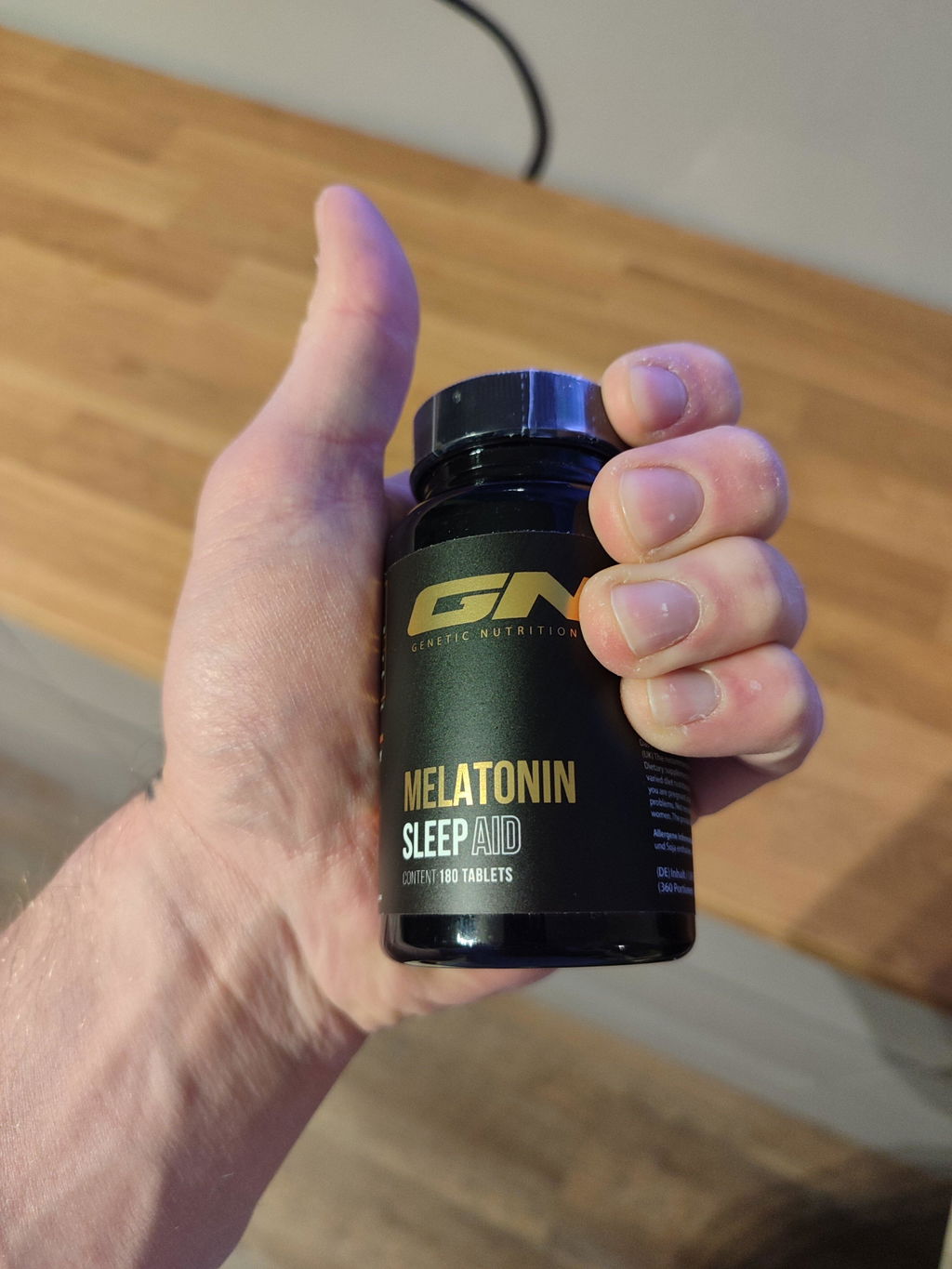
Melatonin 1 mg Tabletten
- ✓ 1 mg Melatonin pro Tablette
- ✓ Teilbar, flexibel dosierbar
- ✓ 180 Tabletten


Du liegst wach, der Kopf ist voll, aber der Körper findet keine Ruhe? Melatonin 1 mg Tabletten von GN Laboratories sind die wissenschaftlich fundierte Lösung für schnelleres Einschlafen und optimale Regeneration.
Die rezeptfreie Einschlafhilfe bietet dir einen Vorrat für 180 Tage und exakt die Wirkstoffmenge, die deinen Schlaf Wach Rhythmus sanft unterstützt, ganz ohne "Hangover" am nächsten Morgen. Kein Überdosierungs Roulette, keine unnötigen Zusatzstoffe. Kaufe jetzt das reine Schlafhormon in Laborqualität und sichere dir den Goldstandard für deine Regeneration.
Das Wichtigste auf einen Blick
- 180 Tabletten – Dein 6-Monats-Vorrat zum Bestpreis
- 1 mg Melatonin pro Tablette – die intelligente Dosierung
- 100% Vegan: Frei von Gluten, Laktose und tierischer Gelatine
- Made in Germany: Laborgeprüfte Qualität & Sicherheit
- Einfach teilbar – Flexibel dosierbar für individuelle Anpassung
- Rezeptfrei erhältlich: Legal und sicher in Deutschland bestellen
| Zusammensetzung | pro 1/2 Tablette | pro Tablette |
| Melatonin | 0,5 mg | 1,0 mg |
Trennmittel (Mikrokristalline Cellulose), Melatonin
Standard: 0,5–1 Tablette 30–60 Min vor dem Schlafengehen
Jetlag: 1mg zur Zielzeit am Ankunftsort
Schichtarbeit: 1mg vor geplanter Ruhezeit
Hersteller / Distributor
GN Laboratories Europe, London / United Kingdom
Nero Labs BV, Postbus 278, 5900AG Venlo, The Netherlands
- Lemoine, P., Nir, T., Laudon, M., & Zisapel, N. (2007). Prolonged-release melatonin improves sleep quality and morning alertness in insomnia patients aged 55 years and older and has no withdrawal effects. Journal of sleep research, 16(4), 372-380.
- Cajochen, C., Krauchi, K., & Wirz-Justice, A. (2003). Role of melatonin in the regulation of human circadian rhythms and sleep. Journal of neuroendocrinology, 15(4), 432-437.
- Garfinkel, D., Laudon, M., Nof, D., & Zisapel, N. (1995). Improvement of sleep quality in elderly people by controlled-release melatonin. The Lancet, 346(8974), 541-544.
- Fonken, L. K., & Nelson, R. J. (2014). The effects of light at night on circadian clocks and metabolism. Endocrine reviews, 35(4), 648-670. doi: 10.1210/er.2013-1051
- Maestroni, G. J. (1993). The immunoneuroendocrine role of melatonin. Journal of pineal research, 14(1), 1-10. doi: 10.1111/j.1600-079X.1993.tb00478.x
- Garfinkel, D., Laudon, M., Nof, D., & Zisapel, N. (1995). Improvement of sleep quality in elderly people by controlled-release melatonin. The Lancet, 346(8974), 541-544.
- National Sleep Foundation. (n.d.). Irregular Sleep Schedules: How They Affect Your Sleep. Sleep Foundation. https://www.sleepfoundation.org/articles/irregular-sleep-schedules-how-they-affect-your-sleep.
- Skene, D. J., Arendt, J., & Cade, J. E. (2005). Use of melatonin in the treatment of phase shift and sleep disorders. Advances in therapy, 22(4), 337-351.
- Herxheimer A, Petrie KJ. Melatonin for the prevention and treatment of jet lag. Cochrane Database of Systematic Reviews. 2002;(2):CD001520. doi: 10.1002/14651858.CD001520
- Ferracioli-Oda, E., Qawasmi, A., & Bloch, M. H. (2013). Meta-analysis: Melatonin for the treatment of primary sleep disorders. PloS One, 8(5), e63773. https://doi.org/10.1371/journal.pone.0063773.
- Dollins, A. B., Zhdanova, I. V., Wurtman, R. J., Lynch, H. J., & Deng, M. H. (1994). Effect of inducing nocturnal serum melatonin concentrations in daytime on sleep, mood, body temperature, and performance. Proceedings of the National Academy of Sciences, 91(5), 1824-1828.
- Reiter, R. J., Tan, D. X., Manchester, L. C., Qi, W., & Garcia, J. J. (2001). Melatonin reduces oxidant damage and promotes mitochondrial respiration: implications for aging. Annals of the New York Academy of Sciences, 939(1), 158-167.
- Amstrup, A. K., Sikjaer, T., Pedersen, S. B., Heickendorff, L., & Mosekilde, L. (2015). The effect of melatonin on the metabolic response to nocturnal life in type 2 diabetes. American Journal of Physiology-Endocrinology and Metabolism, 308(4), E343-E353.
- Gao, Y., Xu, Y., & Guo, Y. (2019). Melatonin supplementation and gastrointestinal tract: impact and possible effects. World Journal of Gastroenterology, 25(32), 4850-4861. https://doi.org/10.3748/wjg.v25.i32.4850.